Rental Registration and BRP Basics in the Netherlands
Understand how registering at a Dutch rental address connects to the BRP and BSN, including the four-month threshold and the five-day reporting rule.
Short version
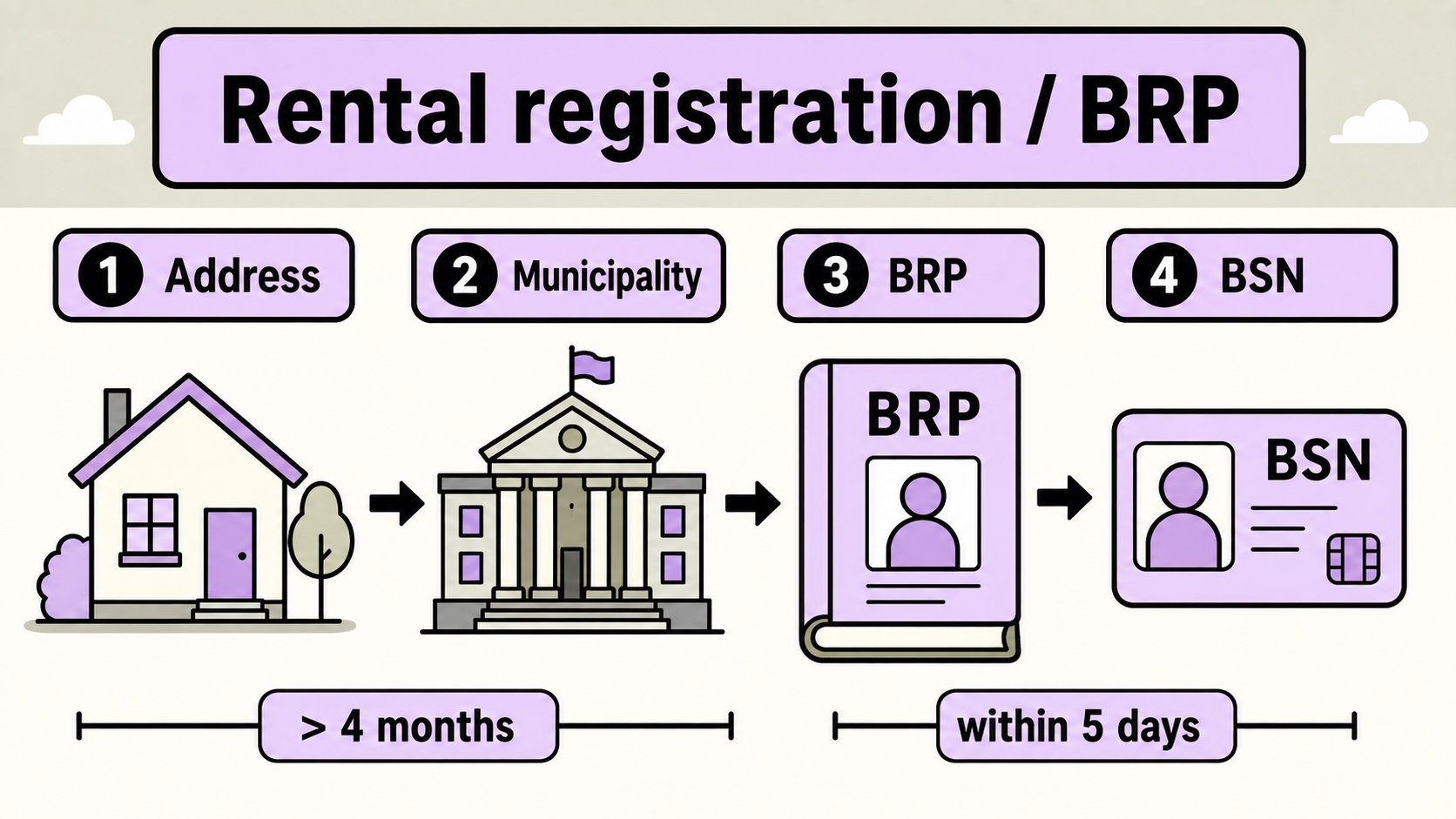
For a renter, Dutch registration starts with the address where you actually live and the municipality that records it. If you expect to live in the Netherlands for more than four months, government guidance says you normally register as a resident in the BRP within five days of arrival. The municipality records the registration and issues a BSN when the registration is completed.
The rule is about your stay and registration status, not only about whether a landlord uses the word “registration” in an advert. A short stay can follow a different path through the RNI. The municipality decides what evidence it needs for the address and the person.
What the BRP records
The BRP is the Dutch personal records database. It holds information about people who live or have lived in the Netherlands and records connected with their address and status. For the record itself, distinguish people, address and status in the BRP explanation from NetherlandsWorldwide, rather than treating registration as a private landlord form.
For a resident, the municipality records the address where the person lives. If there is no fixed home, a correspondence address may be possible when the municipality accepts the circumstances. The address type matters because the registration record should describe the person’s actual situation.
The four-month threshold
The general distinction is:
- More than four months: register as a resident with the municipality where you live.
- Four months or less: a person who is staying temporarily may register as a non-resident through an RNI municipality.
The threshold does not answer every residence or immigration question. Your nationality, lawful stay, household and actual address can change what the municipality asks for. For stays around the four-month threshold, compare your circumstances with the official resident-registration rule: registration is generally required within five days after moving.
The five-day timing rule
If you move to the Netherlands to live for more than four months, the government describes registration within five days of arrival as the general timing. That gives a renter a practical planning point: make the municipality appointment early, collect the evidence it requests and keep the address details consistent across the rental agreement and other documents.
This is not a five-day deadline for an online property application. It concerns registration with the municipality after arrival. A provider may ask a separate question about whether a home permits registration, so keep the two issues distinct.
From registration to BSN
After resident registration, the municipality provides a burgerservicenummer, or BSN. The number supports contact with public authorities and other official processes. It is not proof that a private rental offer is genuine and it does not replace a residence permit where one is required.
Some renters need a BSN before their longer-term housing is settled. A missing BSN can change timing without removing address and provider checks; that distinction matters when renting without a BSN.
The BRP registration questions answer the four-month, five-day, RNI and BSN questions that arise after the address is identified.
What to prepare for the municipality
The exact list varies by situation, but a renter can prepare:
- the intended address and move-in date;
- identification accepted by the municipality;
- the rental agreement or other evidence of occupancy;
- information about household members who are moving with you; and
- any extra evidence the municipality requests for the address or status.
Keep rental application documents separate from municipal registration evidence. Do not assume that a document accepted by a provider is automatically enough for the municipality.
Questions readers ask
Does every rental home allow registration?
Not necessarily. Ask the provider how the address is recorded and verify the position with the municipality before relying on a promise. The registration record should match where you actually live.
Can a landlord register me?
The municipality records the BRP. A landlord can provide occupancy evidence or answer address questions, but the renter remains responsible for arranging their own registration.
Is RNI the same as resident registration?
No. RNI is the record for non-residents, including people who stay in the Netherlands for four months or less in the relevant circumstances. It is not a shortcut that turns a short stay into a resident registration.
Does a BSN prove that I can rent a home?
No. A BSN identifies a person in public administration. A rental agreement, provider identity, lawful stay and registration position answer different questions.
Next step
Keep resident, non-resident and BSN meanings separate with BRP registration for renters, then test address, timing and evidence against the common BRP mistakes. If a question remains unclear, contact us through the form with the question only. Do not include personal documents.
Registration questions depend on your stay, address and municipality. If a landlord or provider gives you unclear registration information, send the wording through the contact form for a focused question. Do not send passports, contracts, bank details or other personal documents.
Ask about registration →