9 Best Cities for Digital Nomads Renting in the Netherlands in 2026
Compare nine Dutch cities for remote workers by legal stay route, rental cost signals, connectivity, newcomer support and everyday workability.
Short version
The best Dutch city for a digital nomad is not necessarily the cheapest or the most famous. First check whether your nationality, client base, employer, stay length and tax position allow the planned work. The Netherlands has no standalone digital-nomad visa, so “best city” is a housing and lifestyle decision after the legal route is understood.
For maximum international infrastructure, begin with Amsterdam, The Hague, Rotterdam or Utrecht. For a different cost and pace profile, compare Eindhoven, Groningen, Arnhem, Zwolle or Enschede. Pararius’ Q2 2026 free-sector signal ranged from €28.69/m² in Amsterdam to €14.95/m² in Enschede; for a simple 50 m² illustration, that is about €1,435 versus €748 before utilities and other costs. The gap is meaningful, but only if the lower-cost city works for your clients, travel and registration needs.
Who this advice is for
- A remote employee or self-employed worker considering a temporary Dutch base.
- A person comparing furnished and unfurnished homes before arrival.
- An EU, EEA or Swiss citizen checking where daily life and work could fit.
- A non-EU visitor who needs to understand the boundary between a short stay and a longer residence route.
- A renter who wants cost, connectivity and administrative support considered together.
This is not immigration, tax or legal advice. A rental agreement does not grant a right to work or remain in the Netherlands. Check the official rules that apply to your nationality, employer, clients and intended stay before booking a home.
The legal route comes before the city
Short stays
Business.gov explains that short stays and longer stays can trigger different conditions. For a non-EU citizen, the ordinary short-stay framework is generally no more than 90 days in a 180-day period. The same guidance says that a non-EU visitor in that situation cannot work for Dutch clients or look for work in the Netherlands. Remote work for a foreign employer or business still needs to be checked against the applicable entry, tax and employment rules.
Longer stays
For a stay beyond four months, a non-EU person may need a residence permit such as the self-employed route, subject to its own requirements. Municipal registration and a BSN may then be part of the move. EU, EEA and Swiss citizens follow different rules. Do not select a city, sign a long contract or describe yourself as a “digital nomad” to a landlord until the underlying route is clear.
What the city can and cannot solve
A city can change your housing cost, access to an official newcomer centre, train connections and the number of suitable neighbourhoods. It cannot create a visa, make Dutch-client work permissible or remove tax and insurance obligations. A support centre can explain administrative steps; it cannot approve your status or guarantee that an address is suitable for registration.
How the shortlist was built
The exact question
The question was: which Dutch cities offer the most workable combination of legal-arrival support, housing cost, connectivity and day-to-day conditions for a remote worker in 2026? This creates a fit-based shortlist rather than a universal “best city” ranking.
Criteria used
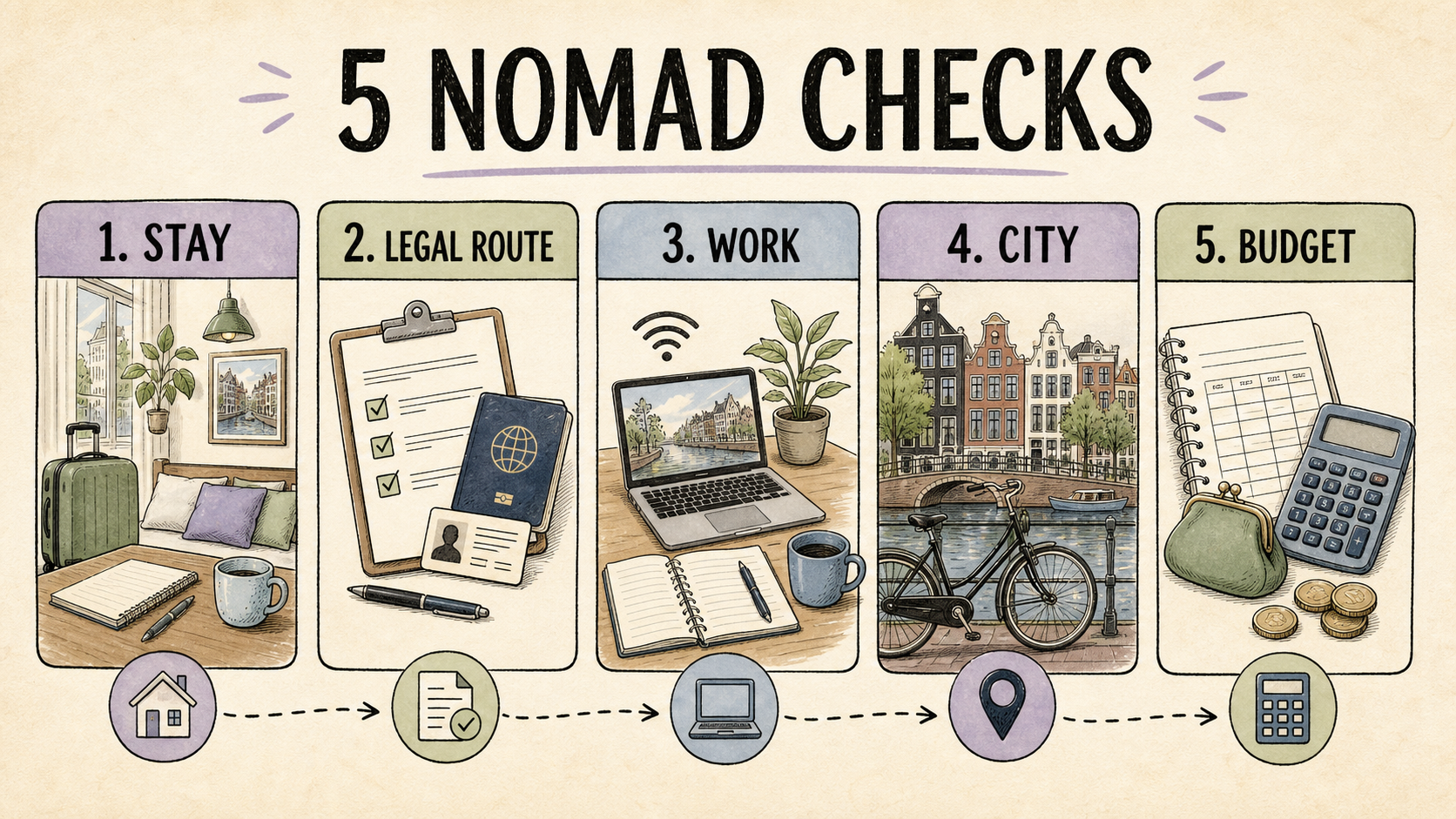
Each city was assessed against five practical questions:
- Legal and administrative starting point: is there official newcomer support nearby, and does the city fit the intended stay route?
- Housing cost signal: how does the Q2 free-sector illustration compare before other costs?
- Connectivity: does the location support train travel, airport access and occasional in-person work?
- Workday fit: can a renter plausibly find a stable home, workspace and routine rather than only a short-stay product?
- Search resilience: is there enough geographic choice to widen the search if the first neighbourhood fails?
How the cost illustrations work
Pararius’ reported average asking rent per square metre is multiplied by 50 m². For Utrecht, for example, €21.61 × 50 = €1,080.50, rounded to €1,081. This is not a quote or a budget recommendation. It excludes utilities, service charges, furnishing, insurance, transport, taxes and the possibility that furnished housing commands a premium.
Nine cities to compare
1. Amsterdam — the strongest international ecosystem
Best for: a remote worker who values international services, airport access, events and the broadest range of professional networks.
What stands out: Amsterdam has an official expat-centre route, dense international infrastructure and excellent rail and air connections. The cost is the clearest downside: the Q2 free-sector signal was €28.69/m², or about €1,435 for 50 m².
Trade-off: high asking rents and competition can push a nomad toward furnished short-term stock, which may not provide the stability or registration position needed for a longer stay. Confirm the contract type and total cost.
2. The Hague — international work with a calmer city scale
Best for: international organisations, policy work, embassies and a renter who wants coastal access with strong South Holland connections.
What stands out: The Hague has an official international centre and a substantial international population. The Q2 signal was €22.42/m², about €1,121 for 50 m², with Rotterdam and Amsterdam reachable for occasional meetings.
Trade-off: districts vary significantly in cost and character. A furnished address marketed to internationals is not automatically a suitable long-term registered home.
3. Rotterdam — urban variety and international connections
Best for: a remote worker who wants a large city, modern neighbourhoods and a lower free-sector signal than Amsterdam.
What stands out: Rotterdam has an official international centre, a major transport network and a Q2 signal of €22.79/m², or about €1,140 for 50 m².
Trade-off: the city is spread out. A cheaper home can add cycling, transit or travel time, and the working environment of a short-stay apartment may not be suitable for a full season.
4. Utrecht — a central rail base
Best for: a worker who expects regular travel to several Dutch cities.
What stands out: Utrecht’s rail position makes it a practical central base, and official international support is available. The Q2 signal was €21.61/m², around €1,081 for 50 m².
Trade-off: centrality brings demand. A flexible radius and a realistic furnishings budget are more useful than assuming that every address will be convenient.
5. Eindhoven — technology corridor and regional support
Best for: a worker connected to technology, engineering, design or a company in Brabant.
What stands out: Holland Expat Center South provides an arrival-support route, and Eindhoven has an international employment base. The Q2 signal was €20.25/m², about €1,013 for 50 m².
Trade-off: a nomad without a local employer may find that the city is less useful than Amsterdam or Utrecht for networking. Check workspace, airport/rail connections and the exact contract before choosing on cost alone.
6. Groningen — a compact northern base
Best for: someone who wants a university-city rhythm, cycling and a lower cost signal while working primarily online.
What stands out: the International Welcome Center North offers regional orientation. The Q2 signal was €19.27/m², around €964 for 50 m².
Trade-off: distance from Schiphol and the Randstad can matter for client meetings. A smaller market may also produce fewer suitable furnished homes at one time.
7. Arnhem — eastern-city balance
Best for: a remote worker who wants rail access, green space and a middle position between larger eastern and central cities.
What stands out: Arnhem’s Q2 signal was €17.37/m², around €869 for 50 m², giving it a lower starting illustration than the major Randstad markets. The city can be a useful compromise when day-to-day work is online and occasional travel is acceptable.
Trade-off: the lower number is an asking-rent signal, not a guarantee of a furnished home with strong internet or a suitable registration arrangement. Check each address.
8. Zwolle — a smaller, connected base
Best for: a renter who prefers a manageable city and can trade international density for a calmer routine.
What stands out: the Q2 signal was €15.21/m², about €761 for 50 m². Zwolle’s rail connection supports periodic travel while its size can make a daily routine simpler.
Trade-off: international support, specialist coworking and short-stay supply may be narrower than in the Randstad. Confirm the work setup before making a long commitment.
9. Enschede — lower cost signal and regional international support
Best for: someone whose work, study or partner is in Twente, or a fully remote worker who values cost more than proximity to Amsterdam.
What stands out: the Q2 signal was €14.95/m², around €748 for 50 m², and Expat Center East Netherlands provides a regional arrival route.
Trade-off: the distance from western client networks is real. The city is a strong cost comparison only when travel frequency, legal registration and furnished availability all fit.
Quick comparison cards
- Most international infrastructure: Amsterdam — strongest ecosystem, highest rent signal.
- Best for international institutions: The Hague — official support and South Holland access.
- Best central rail compromise: Utrecht — useful for travel, still a competitive market.
- Best technology-employer fit: Eindhoven — regional support and a strong work corridor.
- Best lower-cost online-work bases: Zwolle or Enschede — lower illustrations, but less western connectivity.
- Best calmer university-city option: Groningen — compact routine, longer travel to the Randstad.
Choose a city with a five-step decision matrix
- Confirm the work route. Write down nationality, employer or clients, stay length and whether you need a permit, visa or professional advice.
- Separate rent from the real monthly budget. Add service charges, utilities, furnished costs, insurance, transport, workspace and tax advice where relevant.
- Score the city on your fixed constraints. Give each candidate a score from 1 to 5 for legal fit, client travel, housing cost, workspace and everyday routine. A cheap city that scores 1 for travel may be the expensive choice in practice.
- Choose furnished or unfurnished deliberately. A furnished-versus-unfurnished choice can price the setup period instead of comparing basic rents alone.
- Compare actual homes. Put the final candidates into the rental options comparison and verify contract, address and registration conditions before paying.
Frequently asked questions
Does the Netherlands have a digital-nomad visa?
No standalone digital-nomad visa is offered. The route depends on nationality, stay length, employment or business arrangement and other immigration conditions. A city shortlist cannot replace that check.
Can I work remotely from a Dutch rental as a non-EU visitor?
It depends on the exact route and work arrangement. Business.gov explains that the ordinary non-EU short-stay framework is generally limited to 90 days in 180 and does not allow work for Dutch clients or looking for work in the Netherlands. Check your foreign-employer or self-employed situation before arrival.
Which city is cheapest for a digital nomad?
In the Q2 2026 free-sector illustrations used here, Enschede was lowest at about €748 for 50 m², followed by Zwolle at about €761 and Arnhem at about €869. These are not quotes, and furnished stock, utilities and travel can reverse the practical ranking.
Should a digital nomad rent furnished housing?
Furnished housing can reduce setup work for a temporary stay, but it may cost more and may have different contract, notice and registration conditions. Compare the total period cost rather than the monthly headline alone.
Do I need a BSN to rent in the Netherlands?
A landlord or agent may accept an application before you receive a BSN, but screening and registration depend on the home and your situation. Keep registration timing separate from provider policy with the BSN and registration check, then verify the concrete address.
Are coworking and fast internet guaranteed by the city?
No. A city reputation does not guarantee the internet service, sound insulation, desk or workspace in a particular home. Ask for measurable details and include a backup workspace in your budget.
If airport days shape your workweek, compare the separate Schiphol rental-city shortlist for direct-rail, local-connection and shift-time checks.
A practical next step
Choose two cities that fit your legal route and one fallback that fits your full budget. Compare two real furnished or unfurnished homes in each, include travel and setup costs, and verify the address and contract. The right base is the one you can legally use, afford for the full period and work from consistently—not simply the city with the strongest online reputation.
This shortlist combines legal stay boundaries, rent signals and day-to-day workability. A city can look attractive while the immigration or registration route does not fit your situation, so verify that route before paying or signing.
Ask about this digital-nomad guide →