10 cities for expats to consider when renting in the Netherlands
Compare ten Dutch cities for an international move using current free-sector rent signals, travel, density, registration and housing fit.

Short version
There is no single best Dutch city for every expat renter. The useful choice is the city that fits your work or study location, budget, travel pattern, registration need and preferred home type. Use current rent data to set expectations, then score actual listings.
Pararius reported an average free-sector rent of €21.12 per square metre in Q1 2026. Its city figures show a wide spread: Amsterdam averaged €28.53 per square metre, while Bergen op Zoom averaged €14.42 in the report’s qualifying sample. These are professional free-sector listing observations, not a national rent list.
Ten cities and the current rent signal
The figures below are average asking rents per square metre in Pararius’s Q1 2026 report. Where reported, the city samples contain at least 30 withdrawn listings. The 50 square metre figure is simple arithmetic: city average × 50. It excludes service charges, utilities, insurance, transport and furnishing.
Amsterdam
€28.53 per m². A 50 m² illustration is about €1,427 per month. Amsterdam offers the widest concentration of international employers, education and transport connections in this list, with a high housing-cost signal. Check whether a shorter commute offsets the rent difference for your household.
Rotterdam
€22.78 per m². A 50 m² illustration is about €1,139 per month. The city can suit renters who need a large urban job market, port-related work, universities and rail connections while watching the gap to Amsterdam.
Eindhoven
€19.55 per m². A 50 m² illustration is about €978 per month. Technology and engineering employment can be a strong location reason. Check the exact commute because workplaces are spread across the region.
Den Bosch
€20.24 per m². A 50 m² illustration is about €1,012 per month. The city combines a central rail position with a smaller urban scale. Compare supply for your preferred housing type before assuming the per-square-metre signal will be available.
Almere
€19.44 per m². A 50 m² illustration is about €972 per month. Almere may work for a renter who can use the rail connection into the Amsterdam region and values newer housing stock. Price the commute as part of housing cost.
Leiden
€22.69 per m². A 50 m² illustration is about €1,135 per month. Leiden can fit people linked to education, research or the Randstad. Check the balance between smaller-city housing and travel to work.
Haarlem
€24.05 per m². A 50 m² illustration is about €1,203 per month. Haarlem offers proximity to Amsterdam and a distinct city setting. A shorter distance to one workplace can still be offset by a higher asking rent.
Bergen op Zoom
€14.42 per m². A 50 m² illustration is about €721 per month. The lower signal can make the city worth investigating for a renter whose work and registration needs fit the region. Smaller samples and housing mix can move the average.
Enschede
€15.27 per m². A 50 m² illustration is about €764 per month. Enschede’s university and technology links may fit international renters who can work in the east of the country. Check employer location and travel frequency.
Apeldoorn
€15.28 per m². A 50 m² illustration is about €764 per month. Apeldoorn can be a practical base for a renter with regional work, rail access needs or a preference for a less dense city. Confirm the available home type and municipal registration.
What the arithmetic does and does not say
The city examples are a screening tool. €28.53 × 50 equals €1,426.50, rounded to €1,427. €14.42 × 50 equals €721. The difference is about €705 per month for the same assumed size, before the two homes are compared on condition, furnishing, energy, service charges and location.
The city average is not a budget for every address. A 35 m² studio, a furnished 70 m² home and a bare family house should not be compared by city average alone. A furnished-versus-unfurnished choice clarifies how furnishing changes the signal.
Add density as context, not a ranking
CBS reported population density on 1 January 2025 at about 6,901 residents per square kilometre in The Hague, 4,968 in Amsterdam, 4,018 in Utrecht, 3,081 in Rotterdam and 2,829 in Eindhoven. Density helps explain why travel, space and housing type can feel different. It does not measure rental quality or affordability.
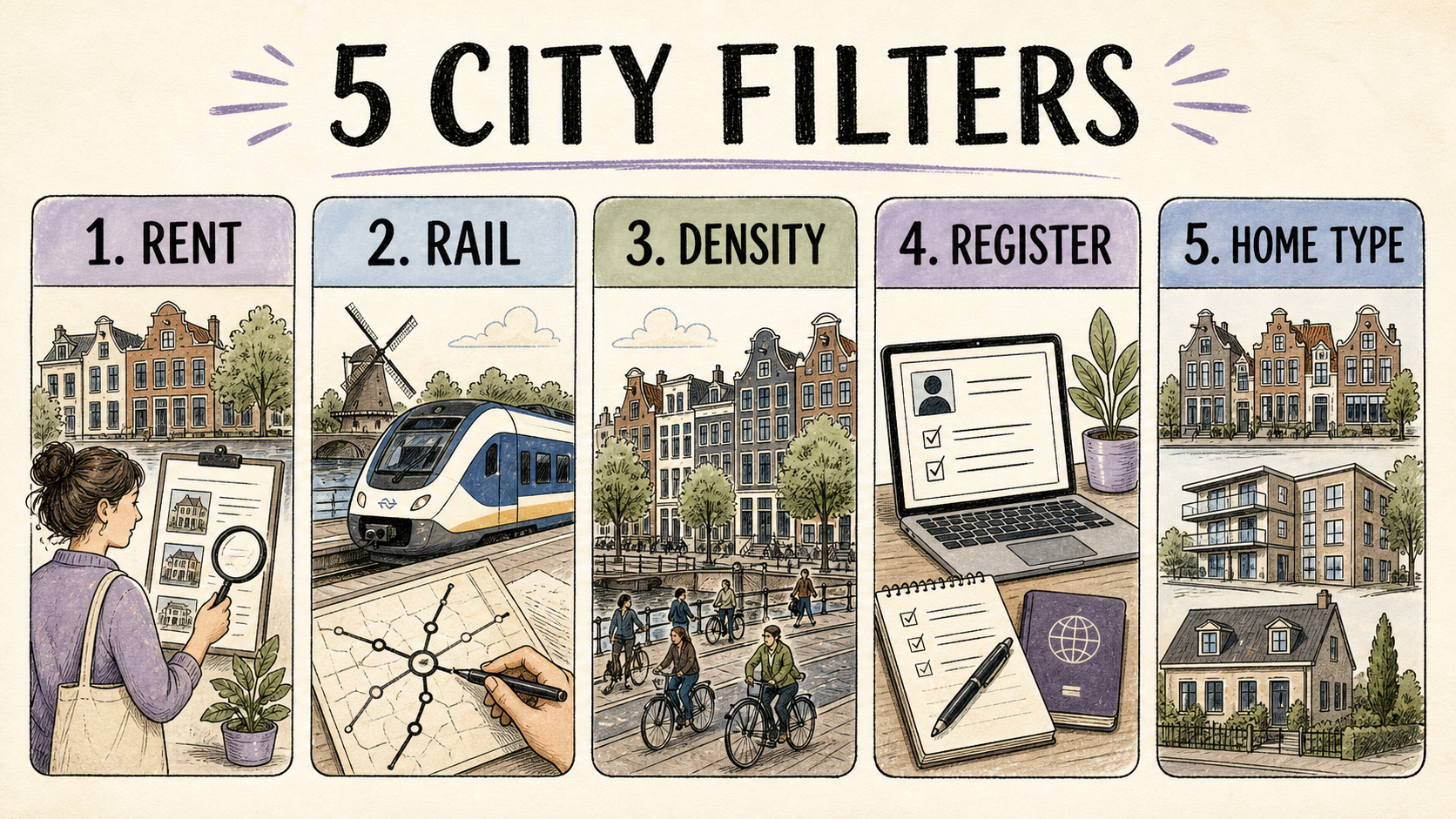
Score a shortlist with five factors
Give each city or listing 0, 1 or 2 points:
Work or study fit: 2 when the ordinary commute is workable, 1 when it works with trade-offs, 0 when the route is unsustainable.
Housing cost: 2 when the full monthly cost fits the budget, 1 when it is close, 0 when it fails before personal spending.
Travel pattern: 2 when daily transport is simple, 1 when it needs several changes, 0 when the travel burden defeats the location.
Registration: 2 when the address and stay route are confirmed, 1 when the municipality still needs to answer, 0 when the home cannot meet the need.
Housing type: 2 when size, furnishing and condition fit, 1 when one compromise is acceptable, 0 when the home fails a fixed requirement.
The maximum is 10. The score helps expose a trade-off. It is not a live city ranking and does not replace a viewing or contract check.
How an expat should compare actual homes
Start with the work or study address, then draw a realistic travel boundary. Within that boundary, compare basic rent, service charges, utilities, registration, furnishing and contract type. If you have no BSN yet, the BSN and registration check separates registration timing from the question of what a city or landlord will handle.
Save the same evidence for each listing. The rental options comparison turns a city shortlist into a property decision.
If your audience is broader than international renters, the 10 cities for renting your own home shortlist compares national options under the same home, budget and registration questions. If basic rent is your first constraint, the cheapest-rental-city shortlist narrows the first filter; apply the same commute, home-type and registration checks.
For students, the student city shortlist weighs study address, housing channel and arrival timing rather than treating an expat-wide shortlist as universal.
If you are arriving before a BSN, compare the cities for renting without a BSN. If you work remotely, the digital-nomad city shortlist adds legal-route and workday checks. For paid search help, compare providers by work area, representation and fee clarity in the rental-agent shortlist for expats before choosing a provider. Before signing, the tenant-rights check adds contract, deposit and rent-increase questions to the decision.
Common mistakes
- Calling a city “best” because its average rent is low.
- Treating asking-rent data as the price of every home.
- Ignoring the return commute when comparing a satellite city.
- Comparing furnished and bare homes without adding furniture and setup.
- Assuming registration follows automatically from a listing.
- Using population density as a quality or affordability score.
- Choosing a city before checking the contract and total monthly cost.
Questions readers often ask
Which Dutch city is cheapest for expat renters?
In the Pararius Q1 2026 professional free-sector sample used here, Bergen op Zoom, Enschede and Apeldoorn had lower average per-square-metre figures than the large Randstad cities. The sample, housing mix and current supply can change.
Is Amsterdam worth the extra rent?
That depends on the value of shorter travel, job access, household income and the home you can actually secure. Compare full monthly cost and commute rather than using a city label.
Should I choose a city before finding a job?
Use a shortlist. A city that looks affordable can become expensive when daily travel is frequent. Score the work or study route, budget and registration path together.
Next step
Choose three cities, score them with the five factors and enter real homes into the rental options comparison. Keep residence, registration and landlord screening separate with the foreign-renter legal framework, then add the charges from the total rental cost to the monthly figure.
The city figures are asking-rent context and the practical fit depends on the home, registration route, commute and timing. Use the list to narrow the search, then test current listings and contract terms.
Ask about choosing a city →