How to rent a home in the Netherlands step by step
A researched sequence for finding, checking, applying for and moving into a rental home in the Netherlands.
Short version
Renting a home in the Netherlands is easier to manage when you treat it as a sequence of checks. Define the home and budget you can accept, verify each listing, inspect the property, prepare only the documents requested, read the contract, confirm registration and record the handover.
Before you start, what renting your own home means defines the self-contained home, while the distinction between self-contained homes, rooms and social housing resolves mixed labels in an advert.
The market rewards preparation. CBS estimates a national housing shortage of almost 400,000 homes in 2025, equal to 4.8% of the housing stock. That is a model-based estimate of the gap between demand and supply, rather than a count of homes you can apply for. In Pararius’s professional free-sector listing dataset for Q1 2026, 12,947 homes were newly available and 14,816 were withdrawn. The average listing was online for 22 days. The figures describe one part of the market, so use them as context while you make a property-level decision.
The Government of the Netherlands tenant plan is the reference for the tenancy checks below.
Build a rental brief before you search
Write down the conditions that would make a home workable:
- Location: one preferred city, two acceptable alternatives and the maximum practical travel time.
- Home: self-contained or shared, furnished or bare, number of rooms, outdoor space and accessibility.
- Timing: earliest move-in date, notice period at the current home and flexibility around the start date.
- Registration: whether you need to register at the address and which municipal process applies to your stay.
- Money: a ceiling for recurring monthly costs and a separate amount for the deposit, first payment, moving and furnishing.
Treat preferences differently from requirements. “Near a station” can be a preference. “Registration must be possible” may be a requirement. This distinction prevents a low advertised rent from hiding a deal that cannot work for your household.
For a structured comparison, record the same fields for every option on the rental options comparison. Include base rent, service charges, utilities, furnishing, deposit, contract type and the evidence you have checked.
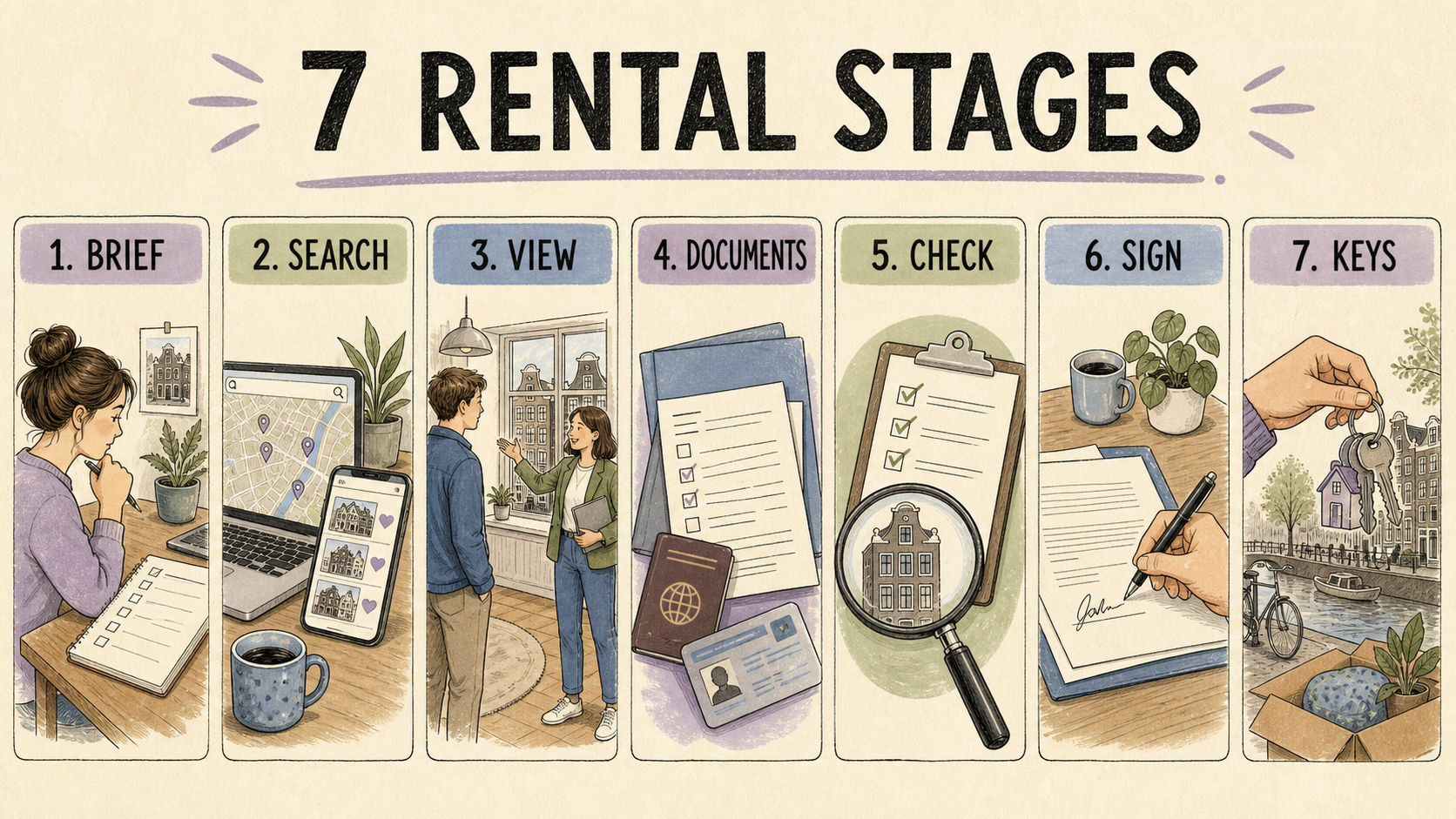
Follow the seven-stage rental sequence
1. Search with the brief beside you
Use reputable housing providers, agents and listing platforms. Save the full listing, date, address, advertised rent, additional charges, deposit, availability and the name of the offering party. A screenshot or PDF can preserve details that later disappear from a listing.
Search terms can be broad at first. Narrow only after you know which conditions remove a home from consideration. A low price with no registration, unclear charges or an unverified advertiser is not a cheaper version of the same home.
A rental-website and app selection can choose a search mix, then verify the original advertiser and current availability.
2. Verify the listing and the person offering it
Ask who owns or manages the property, who will sign the agreement and how the viewing will happen. A genuine listing can still be unsuitable if the person contacting you cannot explain the address, contract or payment method.
Pressure is a decision signal. Pause when the advertiser says you must pay before a viewing, refuses a normal viewing, asks for a large transfer to reserve the home or will not provide written terms. A rental scam checks is useful before sharing money or a complete document pack.
3. Use the viewing to test the listing
Check the entrance, rooms, windows, ventilation, kitchen, bathroom, heating, visible damp, locks and noise. Ask which appliances and fixtures remain. For a furnished home, request an inventory and look for the condition of each item.
Ask three money questions while you are there:
- What is the base rent?
- Which service charges are separate, and how are they calculated?
- Which utilities or services must you arrange yourself?
The answer should match the written offer. A total rental cost clarifies how to turn those answers into a monthly and move-in budget.
4. Prepare a targeted application
A normal application may involve identity, income, employment, household and current-housing information. Send documents that fit the stated selection process. Cover a BSN on an identity copy when it is not needed, and keep a private record of the recipient, date and purpose.
Stage identity and income evidence in the rental document set, then match each request to a stated criterion with the rental application review.
5. Read the agreement before signing
Check the parties, address, base rent, other charges, deposit, start date, duration, notice terms, repairs, house rules, inventory and signatures. Make sure the agreement says what happens at handover and how the condition of the home is recorded.
From 1 July 2023, the government says landlords must give renters a written agreement and information about rights and obligations. Since 1 July 2024, an indefinite contract is the default for new renters, with specific exceptions for temporary agreements. A rental contract review can settle the relevant terms before you commit.
6. Plan registration separately from acceptance
A landlord’s application policy and a municipality’s registration process answer different questions. If you will live in the Netherlands for more than four months, municipal registration is required. A stay of less than four months can fit the non-resident registration process. A BSN and registration check separates the registration process from the limits of renting before registration.
Ask the municipality what evidence and appointment timing apply to your address. Keep a copy of the signed agreement and any written confirmation about registration.
7. Make the handover auditable
Before collecting keys, confirm the first payment, date and time, meter readings, inventory, access devices and condition report. Photograph existing damage with a date in your private records. Store the signed contract, condition report, payment proof and messages together.
At this point, update your comparison notes with the reason you chose the home and the costs you accepted. The record is useful when a service charge, repair or inventory question comes up later.
Use the three-file check before you apply
Listing file: saved advert, address, advertiser identity, viewing notes and written offer.
Home file: condition notes, inventory, utilities, registration answer, travel estimate and questions still open.
Money file: base rent, service charges, utilities, insurance, transport, deposit, first payment and moving costs.
An application is ready when each file contains evidence or an explicit question. If all three files depend on verbal assurances, stop and ask for written clarification.
Common mistakes to avoid
- Comparing homes by advertised rent while ignoring service charges and utilities.
- Sending an unredacted identity copy before knowing why each field is needed.
- Accepting a furnished inventory without recording condition and quantity.
- Signing an agreement with missing parties, charges, dates or signatures.
- Treating “no BSN yet” as an automatic right to a home or as an automatic rejection.
- Paying an agency fee without checking who instructed the agent. The government says the landlord pays when the agent works for the landlord; a tenant who independently commissions an agent can have a different arrangement.
Questions readers ask
How much money should I have before applying?
There is no universal legal amount. Build the recurring monthly budget first, then add the permitted deposit, first payment, moving and furnishing costs. The worked example shows its assumptions.
Can I rent before I have a BSN?
Some renters can apply before receiving a BSN, but landlord screening and municipal registration remain separate. Check the stay length, registration process and the landlord’s written criteria.
Can a landlord charge me a viewing or application fee?
The government’s tenant guidance says a landlord’s rental-agent fee is the landlord’s responsibility when the agent works for the landlord. Ask for the role and fee basis in writing before paying.
Next step
For one property, record the offer in the rental options comparison; the staged rental document set and rental contract review then keep document sharing and signing in the right order.
Each stage produces evidence for the next one, from listing checks to the inventory and keys. If a landlord, payment request or contract breaks that sequence, pause and verify before advancing.
Ask about the rental process →