How to read a rental contract in the Netherlands
A clause-by-clause reading order for rent, points, duration, deposit, repairs, service charges and handover terms.

Short version
Read a Dutch rental contract in this order: parties and address, rent and charges, points and sector, deposit, duration and notice, repairs and house rules, inventory and handover. Compare every line with the home you viewed. Ask for a missing or conflicting term in writing before signing.
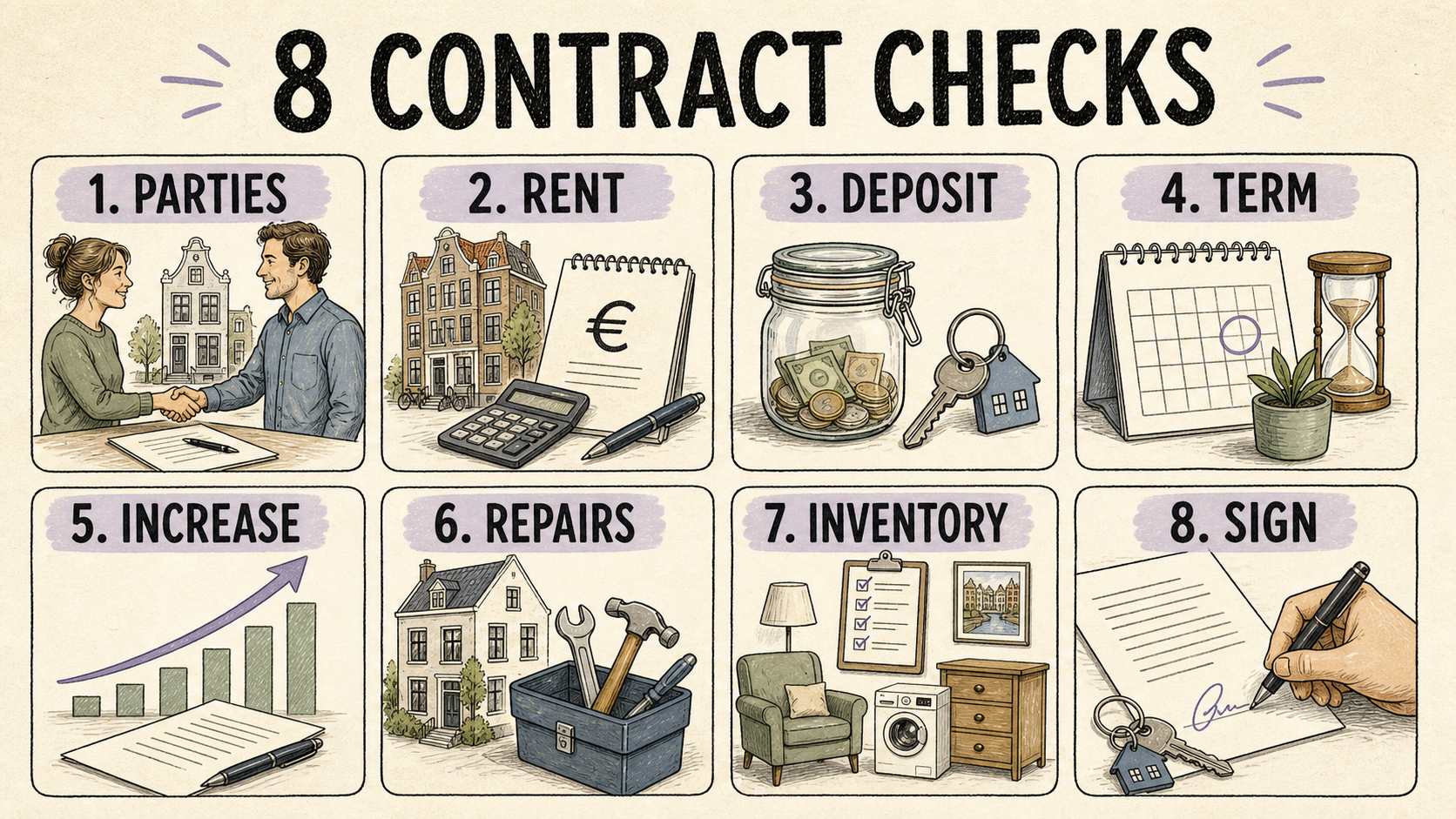
The Rijksoverheid contract guidance says a contract should identify the parties, address, base rent, separate service charges, deposit, start date, payment date, rent-increase date, rules, signatures, point count and condition arrangements. Use that list as a completeness check.
1. Identify the parties, home and start date
Check the full names of the landlord and renter, the address, any room or unit number, the start date and the description of the rented space. The signatory should have authority to offer the home. If an agent signs or communicates, the contract should still make clear who the landlord is.
Match the address to the viewing and the registration question. A contract for a room, a shared home and a self-contained home can have different practical and legal consequences.
2. Separate base rent from other charges
Look for a clear line for base rent and separate lines for service charges. A single all-in figure hides what you are paying for and makes later checks harder. Ask what each service includes, whether it is an advance payment or fixed amount and when the annual statement is provided.
Add utilities, insurance, internet and transport that you arrange yourself. The total rental cost includes a worked budget with assumptions.
Check the payment date, bank details and first-payment amount against the written agreement. A last-minute change to payment instructions deserves independent verification.
3. Check the points and rent category
The Dutch points system helps determine whether an independent home falls into the regulated social, mid-price or private sector. For 2026, the government describes these simple-rent bands for a self-contained home:
- base rent up to €932.93: social sector;
- base rent above €932.93 and up to €1,228.07, with 144 to 186 points: mid-price sector;
- base rent above €1,228.07, with 187 points or more: private sector.
Huurcommissie’s 2026 table gives a useful boundary example: 186 points correspond to a maximum base rent of €1,228.07, while 187 points correspond to €1,234.92. The exact score depends on the home’s size, quality, energy performance and other features. Ask for the point calculation and compare it with the actual home. Do not infer the category from the advertised rent alone.
4. Test the deposit and money at signing
For contracts from 1 July 2023, the maximum deposit is two months of base rent. The government says the deposit should be returned within 14 days after the tenancy ends when there is no permitted deduction. If an eligible deduction is made, the remaining amount should be returned within 30 days, with an explanation.
Permitted deductions include rent arrears, service charges, tenant-caused damage and certain energy-performance charges. Keep the condition report and payment proof so you can compare the home at the beginning and end.
5. Read duration and notice terms
Since 1 July 2024, an indefinite rental contract is the default for new renters. A temporary contract can still exist in specific situations and is generally limited to two years. Read the stated legal basis, end date, notice method and notice period carefully.
Do not assume a label such as “short stay” answers every question. Confirm whether registration is possible, whether the agreement is for an independent home and what happens at the stated end date.
6. Check rent-increase wording
The contract should state when rent can change and which mechanism applies. In the private sector, the maximum annual increase in 2026 is 4.4%, according to Rijksoverheid. That cap is date-specific and does not replace checking the contract, sector and any special rule.
Worked arithmetic: a base rent of €1,500 multiplied by 1.044 equals €1,566 after a 4.4% increase. The example shows the calculation only. It does not establish that a particular clause can be used or that the home is in the private sector.
7. Read repairs, access and house rules
Find the sections on maintenance, defects, reporting, access, alterations, subletting, pets, noise, smoking, shared areas and energy use. The contract should tell you where to report a repair and which party handles it.
House rules can clarify daily use, yet they should not silently change the rent, deposit, notice or statutory rights. Ask for an attached version when the contract refers to a separate document.
8. Match the inventory and condition report
For a furnished or upholstered home, check every item against the inventory. Record quantities, serial numbers when useful, visible damage, keys, remotes and meter readings. A furnished-versus-unfurnished choice clarifies why “furnished” alone is too vague.
Photograph the home at handover and keep the images with the signed report. A clear record protects both sides from a disagreement about pre-existing wear.
A five-minute contract stress test
Ask:
- Can I calculate the recurring monthly amount from the contract?
- Can I identify each party and the rented address?
- Can I explain the point score and rent category?
- Do the deposit and return terms match current guidance?
- Do the duration, notice, repairs and inventory match what was offered?
If a response depends on a verbal promise, write the question down and wait for the answer in the contract or an attached signed document.
Common mistakes
- Treating service charges as base rent.
- Signing before seeing the point calculation for an independent home.
- Accepting a deposit above two months of base rent without checking the contract date and facts.
- Relying on a temporary-contract label without reading the end and notice clauses.
- Ignoring a missing inventory or condition report.
- Using a payment instruction received in a last-minute message without verification.
- Treating a worked percentage example as a ruling on a specific contract.
Questions readers ask
Does every Dutch rental contract need to be written?
Government guidance says rental agreements should be in writing and renters should receive information about rights and obligations. Keep a signed copy.
What is the difference between base rent and service charges?
base rent is the charge for use of the home. Service charges relate to agreed services or facilities and should be listed separately so their calculation can be checked.
Can the landlord use any rent-increase percentage?
The allowed maximum depends on the sector, date and contract. For the private sector, Rijksoverheid lists a 4.4% maximum for 2026. Check the official current guidance when the increase is proposed.
For privacy, repairs, deposits, service costs and misconduct, tenant rights in the Netherlands adds the questions that sit outside the contract itself.
Next step
A rental process sequence can gather the right documents, then add the contract figures to the rental options comparison.
The useful question is not whether a contract looks standard, but what its rent, duration, repairs, charges and handover terms mean for your situation. Mark unclear clauses and verify date-sensitive rules before signing.
Ask about a rental contract →