What landlords can ask for in a Dutch rental application
A fair, privacy-aware guide to rental application questions about identity, household, income and registration in the Netherlands.

Short version
A landlord can ask for information that is relevant to selecting a tenant and checking whether the agreement is workable. The Rijksoverheid examples include name, address, contact details, household composition, total monthly net income, income evidence and current rent or a landlord statement. The selection process should be clear, transparent and non-discriminatory.
The Rijksoverheid housing-market guidance says a landlord must use published, transparent criteria and explain the choice to rejected candidates. Since 1 January 2024, municipalities have a reporting point for problems covered by the Good Landlordship Act. These rules help you assess a request, though a specific dispute still depends on its facts.
Use the three-gate application framework
Gate 1: who will rent?
Relevant questions can include:
- who will sign the contract;
- who will live in the home;
- household composition;
- intended start date and current address;
- contact details for the application.
The request should connect to occupancy, communication or the agreement. A landlord does not need a biography of your private life to identify a tenant.
Gate 2: can the household meet the payment terms?
The stated process may request total monthly net income and evidence such as an income declaration, annual statement or recent payslips. A private landlord may ask for the last three payslips as an example of recent income evidence. If a partner or co-renter is applying, their relevant information can be considered too.
The income test should explain which amount is used and how variable income, benefits or self-employment are treated. A common “three times gross rent” rule is a landlord practice seen in the market, not a universal legal threshold. Ask for the rule in writing rather than assuming it applies to every home.
Gate 3: does the proposed tenancy fit the home and criteria?
The landlord can assess facts connected to the home, such as the number of occupants, a current landlord statement, rent history or the need for registration when those are part of the published criteria. A rental document set clarifies how to share relevant evidence while covering unnecessary identifiers.
The outcome should follow the same criteria used for other applicants. If you are rejected, the government guidance says the reason for choosing another candidate should be explained.
Questions that raise a rights concern
Rijksoverheid states that selection cannot be based on characteristics such as ethnic or cultural background, religion, political views, sexual orientation or health. A request that asks for one of those characteristics, or uses it as an unexplained selection filter, deserves a written clarification.
The phrase “we prefer a certain type of tenant” is too vague to be a transparent criterion. Ask:
- What objective requirement is being tested?
- Which document proves it?
- Does the same rule apply to every applicant?
- How will the information be stored and when will it be deleted?
Keep the question and answer in your application log. If a landlord will not state the criterion or applies it inconsistently, pause before sharing extra personal data.
Privacy: make the request specific
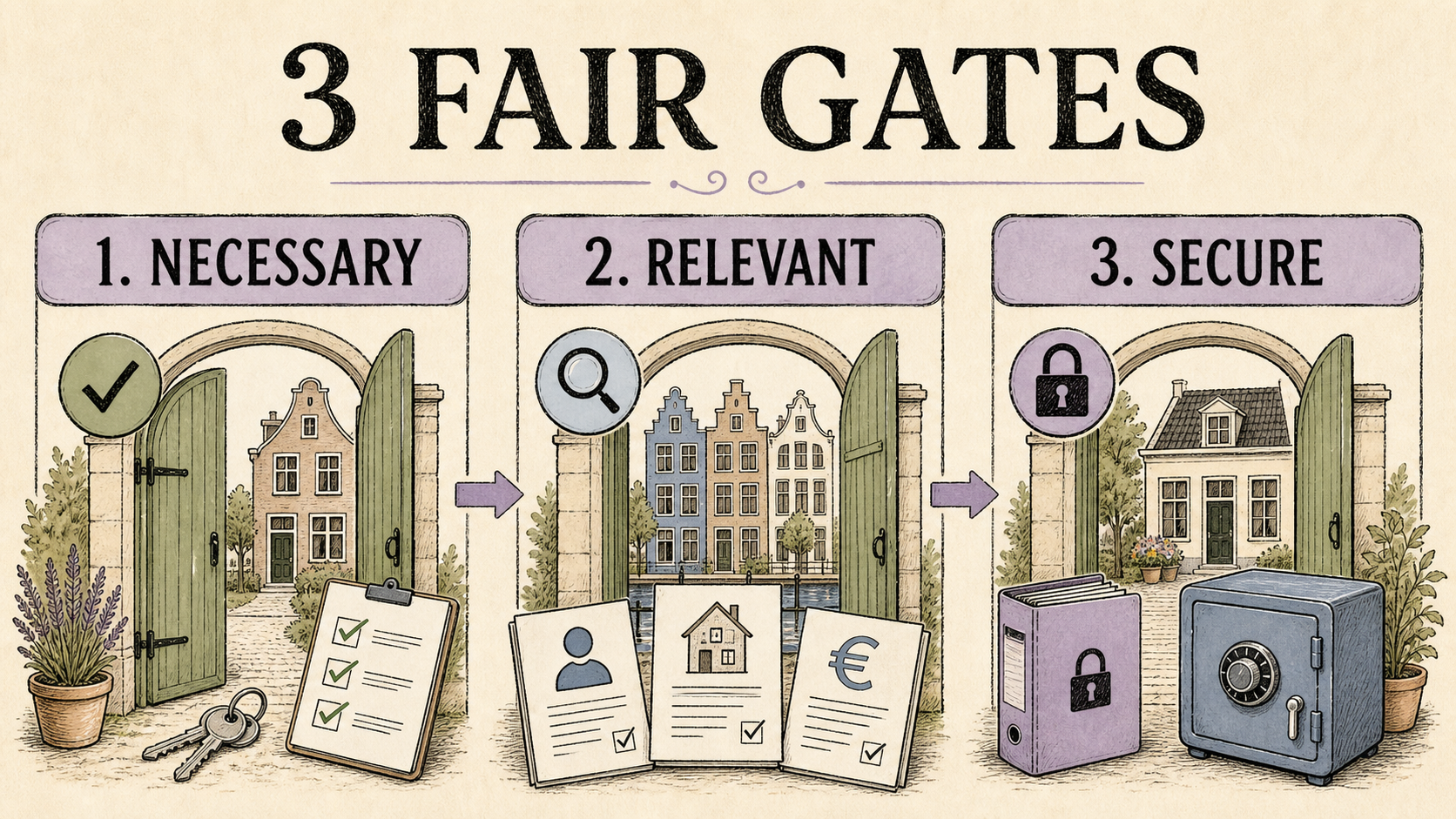
Apply a necessity, currency and security test to every file. A request for income evidence can be relevant, while a complete identity copy with every identifier visible may contain more information than the initial assessment needs.
You can ask whether a BSN is required and cover it when it is not. You can also ask whether an inspection is enough before sending a copy, which fields must remain visible and which secure channel to use. Do not send sensitive documents to an unverified contact or a listing that has skipped a normal viewing.
What a fair process should show
Look for:
- a stated application deadline or order;
- the criteria used to choose a renter;
- the documents needed at each stage;
- an explanation of how multiple candidates are compared;
- a clear rejection explanation;
- a way to report a concern to the municipality when the Good Landlordship Act applies.
The national rules of good landlord practice require clear and transparent selection and prohibit discrimination and intimidation. An ordinary request for relevant income evidence can be legitimate. A hidden, shifting or personal preference is a different signal.
A simple evidence map
Identity: name, signatory and contact details. Share only the fields needed for the stage.
Affordability: stated income and current evidence, with the calculation method explained.
Occupancy: household composition and intended use of the home.
Housing history: current rent or a landlord statement when included in the criteria.
Registration: a practical question about the address and stay, separate from a judgment about nationality or background.
Use this map to answer a request in a short, organized way. A rental process clarifies where the application sits in the wider sequence.
Common mistakes
- Assuming every question is automatically allowed because it appears on a form.
- Sharing health, religion or background information that is irrelevant to the rental.
- Treating an income multiple as statutory law.
- Sending an unredacted identity copy before the selection stage requires it.
- Accepting a vague “preferred profile” without objective criteria.
- Forgetting to ask why a file is needed and how it will be handled.
- Paying money to improve your position in a queue without a written, verified agreement.
Questions readers ask
Can a landlord ask for payslips?
Income evidence can be relevant to a rental application. Rijksoverheid lists an income declaration, annual statement and recent payslips as examples for a private landlord. The request should fit the stated process.
Can a landlord ask about my background or health?
Rijksoverheid says selection cannot be based on ethnic or cultural background, religion, political views, sexual orientation or health. Ask for the legal and practical reason for any sensitive question.
What can I do if the selection seems discriminatory?
Save the advert, criteria, questions, documents sent and messages. Ask for the selection reason in writing and use the municipal reporting point or an appropriate support service when the facts warrant it.
Next step
Prepare the minimum relevant pack with the rental document set, then compare the home’s complete monthly cost before you apply.
Landlords may need information to assess an application, but identity, income, household and registration questions should be proportionate and explained. Keep a record of what was requested, why and when it was sent.
Ask about application documents →