Common Mistakes in a Dutch Rental Timeline
Avoid six timing and document mistakes that can make a Dutch rental application slower, riskier or harder to assess.
Short version
Most rental-timeline problems begin with a wrong assumption about what a stage proves. A viewing is treated as approval, a document bundle is sent before the purpose is clear, money is transferred before written terms arrive, or BRP registration is mixed with landlord selection. Correct the stage first; sending more information rarely fixes the wrong stage.
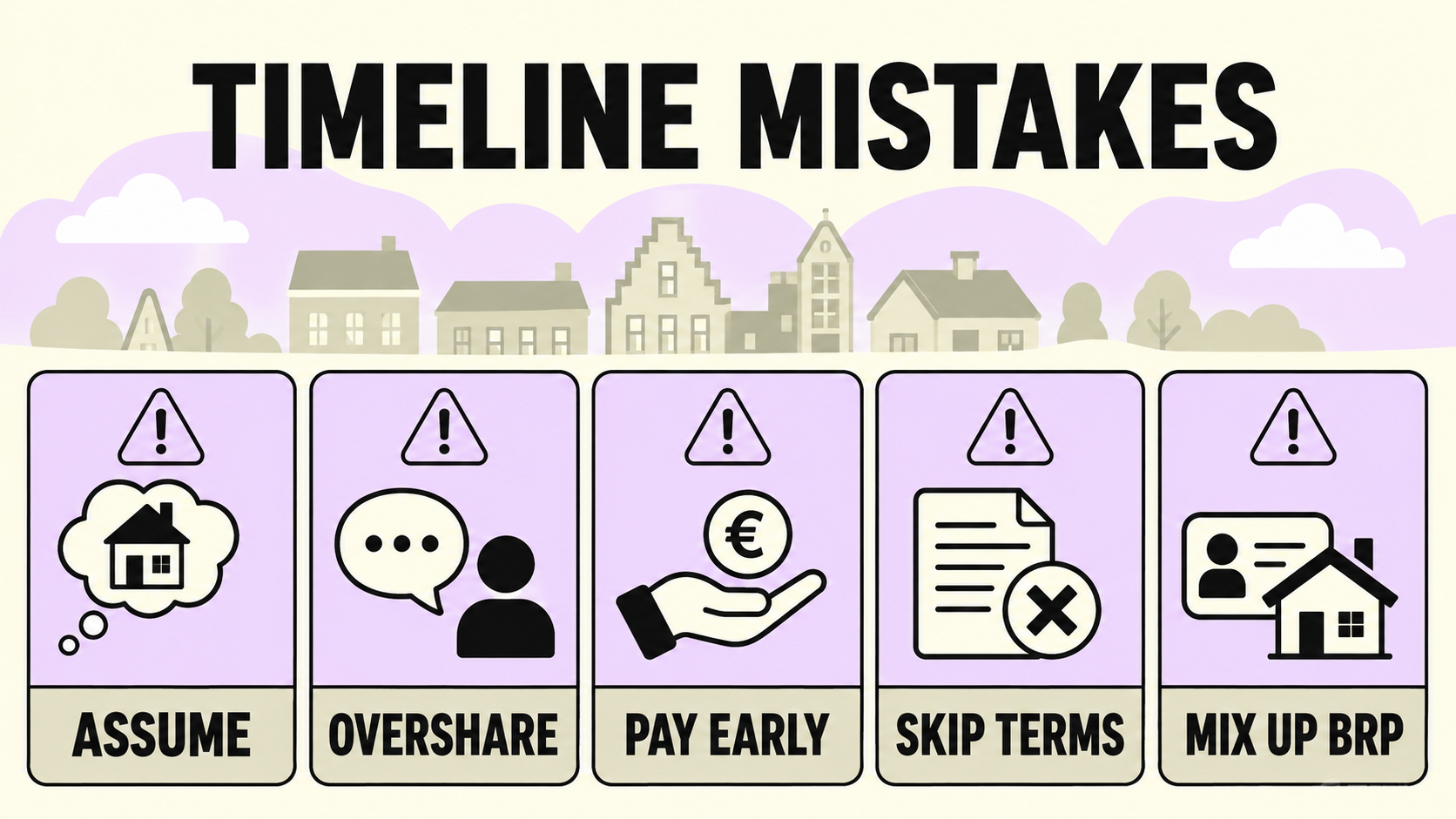
Correct it: Confirm the party, address, written agreement, purpose of the payment and refund conditions first. For agreements from 1 July 2023, the tenant step-by-step plan from the Dutch government says a deposit may not exceed two months of base rent.
Correct it: Keep two lines in the timeline. For a stay longer than four months, the BRP registration timing rule normally points to registration within five days of arrival. Confirm the municipality’s evidence requirements separately.
If you are preparing to buy after renting, keep the documents needed to buy a house in the Netherlands in a separate file for the property, financing and transfer stages.
Who this helps
This is for a renter moving through a Dutch home search, especially when several dates and document requests arrive at once. It is also useful when a provider gives a short response such as “send everything today” without describing the decision, recipient or next handoff.
Six timing mistakes and the correction for each
1. Treating a viewing as an acceptance
The mistake: You assume that attending a viewing means the home is yours or that the provider has already chosen you.
Why it causes trouble: The provider may still be comparing applicants, checking documents or deciding whether the home is available. You can make commitments based on a decision that has not happened.
Correct it: Mark the viewing as an inspection and ask what confirms acceptance. Keep searching until the provider identifies the next decision in writing.
2. Sending every personal document at the first request
The mistake: You send an unredacted passport, bank statement, employment file and contract history before knowing who receives them or why.
Why it causes trouble: Extra documents do not create a faster decision. They increase exposure and can make it difficult to tell which evidence actually supports the application.
Correct it: Use a staged bundle. Start with the category requested, ask for the purpose and recipient, and redact information that is not relevant. Keep identity, income, address and right-to-stay records distinct with the Dutch rental-application document set.
3. Paying before verifying the terms
The mistake: You pay a deposit, reservation charge or first month’s rent because a message says the home will otherwise go to someone else.
Why it causes trouble: Payment does not prove that the sender is entitled to rent the home or that the stated conditions are complete.
Correct it: Confirm the party, address, written agreement, purpose of the payment and refund conditions first. For agreements from 1 July 2023, the tenant step-by-step plan from the Dutch government says a deposit may not exceed two months of base rent.
4. Skipping terms because the move-in date feels urgent
The mistake: You check only the rent and start date, then sign without checking service costs, contract term, repairs, access, notice and payment instructions.
Why it causes trouble: A quick signature can create a slower dispute. The missing term appears when the home is occupied and the parties remember the conversation differently.
Correct it: Use a fixed review order. The rental-contract checks for rent, term, deposit, repairs and access turn urgency into a list of questions without treating a checklist as a substitute for the written terms.
5. Mixing BRP registration with selection
The mistake: You treat a landlord’s answer about registration as proof that your municipal registration is complete, or you delay municipal planning while waiting for the provider’s selection decision.
Why it causes trouble: The provider chooses a renter; the municipality records a person’s actual residence under its own rules. They are related to the address but not the same decision.
6. Treating silence as a confirmed delay
The mistake: You assume that no reply means rejection, acceptance or a fixed delay.
Why it causes trouble: Silence can reflect an incomplete application, a provider’s internal review or a missing contact detail. Guessing changes your next action without evidence.
Correct it: Send one short status question that names the application date, the outstanding item and the decision you need. Give the recipient a clear way to answer instead of adding another bundle of documents.
A simple repair sequence
When the timeline feels stuck, write down four items:
- The last event that is actually confirmed.
- The next decision that must be made.
- The evidence needed for that decision.
- The person or organisation that can confirm it.
This makes a difference between “I have waited three days” and “the provider has not confirmed whether screening is complete.” The second statement can produce a useful question.
Questions readers ask
Should I stop searching after sending an application?
Not until acceptance and written terms are confirmed. Keep alternatives open when the home is competitive or the provider has not supplied a decision date.
Is a large document bundle always a stronger application?
No. Relevant, controlled evidence is stronger than unrelated personal records. Ask which category is needed and keep a record of what you send.
Is a short response time proof of a scam?
No. Urgency is a warning signal, not a conclusion. Verify identity, the property, the agreement and the payment method before transferring money or sharing sensitive data.
Next step
Label the last confirmed event in your timeline and write the one decision still missing. If the provider’s wording remains unclear, send a focused question through the contact form without attaching personal documents.
A delay may come from one missing decision, not from a lack of paperwork. If a provider’s timing or document request is unclear, send the wording through the contact form. Do not send passports, contracts, bank details or other personal documents.
Ask about a rental decision →