Renting vs Room-Renting vs Social Housing in the Netherlands
Compare a self-contained rental, room rental and social housing by facilities, access, price rules, eligibility, registration and daily use.

Short version
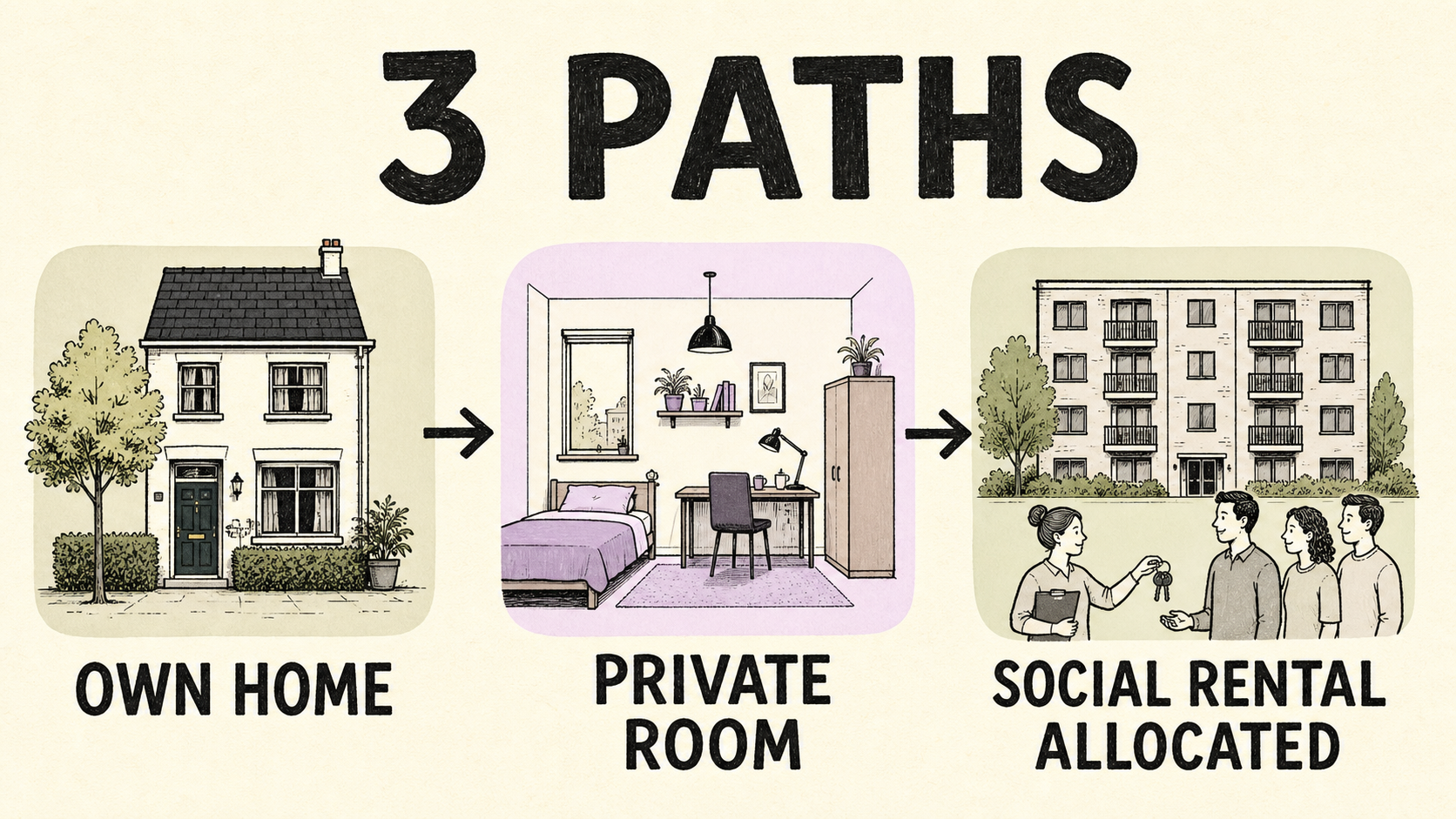
Compare three separate questions: Do you want private facilities? Can you use a shared home? Do you meet the access rules for regulated social housing? A self-contained rental normally gives one household its own entrance, kitchen, toilet and bathroom. A room gives private space with one or more shared facilities. Social housing concerns regulated rent and allocation, and a social home can also be self-contained.
Start with the facilities, then read the agreement, price rules, registration position and access conditions. A rental basics sets out the terms used in this comparison.
The three housing choices
Self-contained rental
A self-contained home has its own entrance, kitchen, toilet and bathroom. The offer can sit in social, mid-price or private rental. The household compares the full cost, contract, location, facilities and registration position with other offers.
This category answers a physical question: which facilities belong to the household’s unit? A meaning of renting your own home clarifies the difference between private use and ownership.
Room rental
Room rental gives the tenant a private room while one or more facilities are shared. The agreement can state the room, address, rent, house rules and shared areas. A room may suit someone who values a lower starting cost or short-term flexibility and accepts less private space.
Ask who cleans, uses and repairs shared facilities. A lower advertised amount can carry time, privacy and house-rule costs that a headline price leaves out.
Social housing
Social housing is a regulated rental context with access and income conditions that can apply through a housing association or another provider. Waiting time, household composition and income can affect access. Read the current provider criteria for the offer you are considering.
Social housing can be a self-contained home. The word “social” answers a rent and allocation question, while “self-contained” answers a facilities question.
Where the categories overlap
These labels sit on different axes:
- Facilities: self-contained home or shared room.
- Rent sector: social, mid-price or private.
- Access: open application, provider criteria, income conditions or waiting time.
- Registration: address and expected stay determine the municipal question.
A social self-contained home can fit the first two descriptions at once. A room can have regulated rent rules while remaining room rental because a kitchen or bathroom is shared. A private self-contained home can have open application while still requiring a full cost and contract review.
The distinction between self-contained homes, rooms and social housing keeps these axes separate.
Compare the choices by five questions
1. Which facilities are private?
Walk through the entrance, kitchen, toilet, bathroom, laundry and outdoor space. Ask whether another household uses each area. A floor plan and viewing notes are stronger than a label such as “studio” or “own apartment”.
2. What does the agreement cover?
Check parties, address, room or unit, base rent, other charges, deposit, start date, duration, notice, repairs, access, house rules and inventory. Shared areas deserve clear arrangements about cleaning, storage and visitors.
3. Which price rules apply?
For self-contained agreements starting in 2026, government guidance uses these initial-rent markers:
- Social: up to €932.93.
- Mid-price: above €932.93 and up to €1,228.07, with 144 to 186 points.
- Private: above €1,228.07 and at least 187 points.
The point position, home type, initial rent and agreement date still need review. Rooms have their own rent assessment because shared facilities affect the calculation.
4. Who can apply and when?
Private offers may use a stated selection process. Social offers can require income, household and provider conditions, and a waiting position may matter. Room offers may use household or age conditions. Read the specific criteria and record the application date.
5. Can the household register and live well there?
Ask the landlord or provider what the agreement says about registration. Ask the municipality which process and evidence apply to the expected stay. Then test commute, privacy, noise, storage, cooking, work or study space and access to daily services.
A full-cost comparison
Price the whole month, not only the advertised rent. Here is an illustrative contrast:
- Room: €800 rent + €150 other monthly costs = €950.
- Self-contained home: €950 rent + €200 other monthly costs = €1,150.
The second example is €200 higher, or 21.1% above the first total after rounding. The values are planning figures. They show how utilities, charges and routine costs can change a category decision. Add deposit, first payment, travel, insurance, furniture and moving costs separately. The rental-cost breakdown separates the charges, and the rental options comparison records each real amount.
Three decision examples
A household that needs private facilities
Start with self-contained offers. Check whether the home supports registration, the full cost fits and the contract names every charge. A social self-contained offer may fit when the household also meets provider and income conditions.
A renter prioritising a lower starting amount
Compare rooms with smaller self-contained homes. Price shared-facility time, travel, furniture, utilities and privacy. A room can lower the monthly amount while creating house-rule limits or a longer journey.
A household that may qualify for social housing
Check the provider, income conditions, household rules and waiting position. Keep social access questions separate from the physical question of whether the home is self-contained. A regulated offer still needs contract, facility and registration checks.
Common comparison errors
- Treating “social” and “self-contained” as competing labels when one describes rent and the other describes facilities.
- Comparing a room’s advertised amount with a self-contained home’s full cost without adding shared utilities and travel.
- Assuming a social offer is available immediately when provider criteria or waiting time apply.
- Reading “studio” as proof that all facilities are private.
- Asking about registration after paying a deposit or signing a contract.
Questions readers ask
Is social housing always a separate building type?
No. Social housing describes regulated rent and access conditions. The home itself can be self-contained, and its facilities still need their own check.
Is room rental always cheaper?
Room rental can have a lower advertised amount. Add shared utility costs, travel, furnishings, house-rule limits and the value of private facilities before deciding.
Can I register in a room?
Registration depends on the address, expected stay and municipal requirements. Ask the provider what the agreement says and confirm the process with the municipality.
Does a higher rent mean private-sector rental?
The 2026 thresholds for self-contained homes use initial rent, points and agreement date. Check the actual point position and current government guidance before drawing a conclusion from the amount alone.
Which choice works best for an international renter?
Start with registration, contract language, income evidence, facilities and the expected stay. A BSN and registration check can form one part of that review.
Next step
Write down your required facilities, maximum full-month cost, registration need, access conditions and preferred term. Write down the required facilities, full-month cost, registration need and term; the rental options comparison records two offers, while the distinction between self-contained homes, rooms and social housing resolves mixed labels.
The common mistakes with these rental categories flags avoidable risks, while the questions about the three rental categories organizes the decision before documents or a deposit change hands.
A room, a self-contained rental and a social-housing offer answer different housing questions, and social housing can also be self-contained. If a listing combines labels or leaves facilities and registration unclear, send us the wording through the contact form before you compare amounts.
Ask about rental categories →