9 Best Cities for Retirees Renting in the Netherlands in 2026
Compare nine Dutch cities for older renters by rent signal, age profile, access, housing fit and support checks.

Short version
The best Dutch city for a retiree renter depends on the everyday pattern around the home: stairs, shops, public transport, social contacts, local services, housing costs and the support questions that may matter later. This comparison covers nine cities using three dated inputs: Q2 2026 asking-rent signals, a CBS 2025 age-profile signal and a practical housing-fit screen.
Apeldoorn is the strongest all-round starting point in this shortlist because its 50 m² rent illustration is about €778 and its 65+ eligible-voter signal is 29.1%. Amersfoort offers a central travel position with a higher illustration of about €888. Enschede and Zwolle produce lower basic-rent examples at about €748 and €761. None of those figures says that a suitable, step-free or available home exists at that amount.
Who this advice is for
- Older renters moving to a smaller or more manageable city.
- Couples comparing access and monthly cost before downsizing.
- Family members helping someone assess a new rental area.
- Renters who want to ask better questions about stairs, services, travel and contract terms.
Choose the national city shortlist for a broad rental screen and the cheapest-rental-city shortlist for a budget-first filter. Neither answers care eligibility, medical suitability or municipal support for a particular household.
How the shortlist was built
The question
Which Dutch cities give an older renter a workable combination of rental cost, daily access, transport and housing-fit questions in 2026?
The four filters
- Rent signal: a Q2 2026 professional free-sector city signal, shown as an illustrative 50 m² basic rent.
- Age-profile signal: the 2025 CBS share of eligible voters aged 65 or older, used to compare the shape of a city’s older voting population.
- Daily access: a short list of shops, pharmacy, GP, community activity, green space and public transport questions to check at address level.
- Home fit: step-free access, lift, bathroom layout, storage, light, noise, heating, service charges and registration.
The first two filters are numbers. The last two require a viewing and a local check. An age-profile signal does not prove that a neighbourhood has the services you need. It simply helps you form a question about the local routine.
What the rent examples mean
The calculation is:
Q2 asking-rent signal per m² × 50 m² = illustrative basic rent
Apeldoorn is €15.55 × 50 = €777.50, rounded to €778. Amersfoort is €17.76 × 50 = €888. The figures exclude service charges, energy, insurance, travel, furnishing and move-in costs. A complete budget combines the per-m² signal with the total rental cost, including recurring and move-in costs.
Why age data needs careful reading
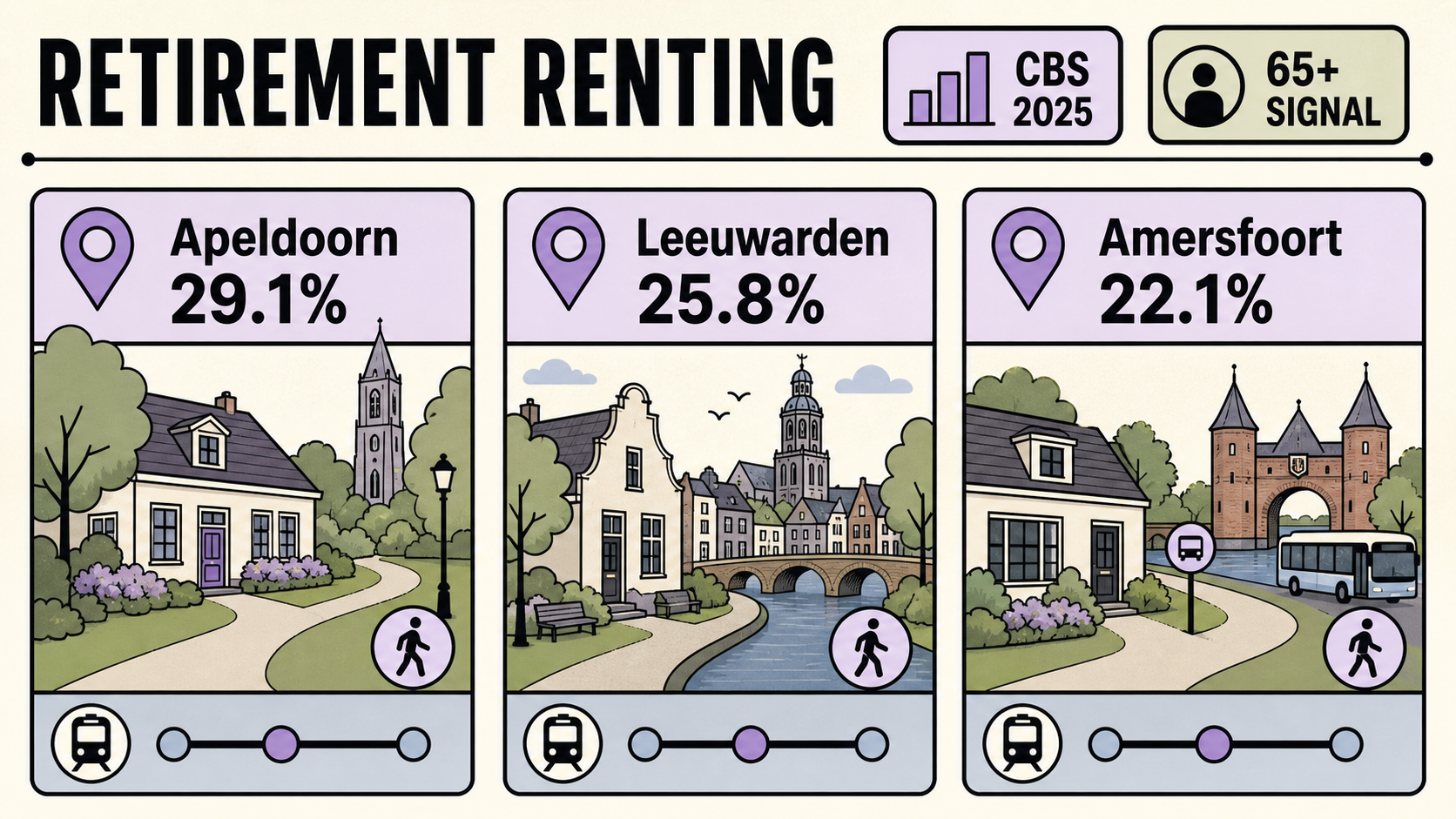
CBS reported that 20.8% of the Netherlands’ eligible voters were 65 or older in its 2025 comparison. The city figures above are the share among eligible voters, not the share of every resident. People who are not eligible to vote, such as some residents without Dutch nationality, are outside that denominator. Use the values as a comparative signal, not as a count of older residents or a care-demand forecast.
The practical question is more useful than the ranking: what will a normal Tuesday feel like from this address? Walk the route to a food shop. Check the pavement, crossing points and seating. Look at the distance to public transport. Ask the municipality what support is available and whether the building is easy to adapt. Government guidance explains that municipalities can provide support through the Wmo; eligibility and the form of support depend on the person and local assessment.
Nine cities to compare
The order is an editorial fit shortlist. It balances the four filters above. It is not an official age-friendly ranking.
1. Apeldoorn — a balanced first screen
Q2 signal: €15.55 per m². 50 m² illustration: about €778. CBS 65+ signal: 29.1% of eligible voters in 2025.
Apeldoorn combines the highest age-profile signal in this group with a lower rent illustration. It is a strong first city to test for someone who wants a sizeable city with a calmer daily pattern. The number does not tell you whether a particular district has a lift or the services you need.
Check next: step-free entries, local shopping distance, bus stops, GP access, service charges and the building’s future adaptability.
2. Amersfoort — central travel with a higher budget
Q2 signal: €17.76 per m². 50 m² illustration: about €888. CBS 65+ signal: 22.1%.
Amersfoort can fit a renter who wants a central position for family visits or regular appointments. Its basic-rent illustration is higher than Apeldoorn and Enschede, so travel convenience has to justify the difference in your own routine.
Check next: station and bus access from the exact neighbourhood, walking surfaces, noise, lift availability and the total monthly charge.
3. Zwolle — low signal with a regional city routine
Q2 signal: €15.21 per m². 50 m² illustration: about €761. CBS 65+ signal: 22.6%.
Zwolle gives a low starting illustration and a city scale that can suit a renter who wants daily services without the largest urban footprint. The Q2 signal rose 12.19% year on year, so date and listing-level evidence matter.
Check next: neighbourhood services, cycling and bus alternatives, lift or ground-floor stock and contract charges.
4. Leeuwarden — a northern option with a strong age signal
Q2 signal: €15.26 per m². 50 m² illustration: about €763. CBS 65+ signal: 25.8%.
Leeuwarden offers one of the lower illustrations and one of the higher comparative age signals. It can suit someone whose family, activities and appointments are in the north. Long trips to the Randstad can change the budget and the sense of convenience.
Check next: travel to family or specialist appointments, local transport, winter walking conditions and building access.
5. Enschede — the lowest basic-rent illustration
Q2 signal: €14.95 per m². 50 m² illustration: about €748. CBS 65+ signal: 24.9%.
Enschede has the lowest city signal in this group. It can work for a renter with family or social ties in Twente, or for someone who values budget space and a regional routine. The lower amount is less useful when important contacts are far away.
Check next: travel to family, access to daily services, neighbourhood slopes and the difference between basic rent and total cost.
6. Arnhem — urban services with a lower rent signal
Q2 signal: €17.37 per m². 50 m² illustration: about €869. CBS 65+ signal: 22.0%.
Arnhem offers a stronger urban comparison than the smallest markets while staying below the national Q2 signal. A renter may accept a higher basic rent for easier access to activities, public transport or family connections.
Check next: hills and walking distances, lift access, noise, parking or transit, and the exact home’s energy costs.
7. Nijmegen — city life with a €915 illustration
Q2 signal: €18.29 per m². 50 m² illustration: about €915. CBS 65+ signal: 21.7%.
Nijmegen is a candidate for someone who wants a lively regional city and accepts a higher basic-rent illustration. The age-profile signal is close to the Dutch comparator used here, so the city label cannot replace a neighbourhood visit.
Check next: quiet streets, stairs and lifts, daily shopping distance, public transport and charges for a larger or adapted home.
8. Alkmaar — north of the Randstad
Q2 signal: €17.17 per m². 50 m² illustration: about €859. CBS 65+ signal: 21.4%.
Alkmaar can fit a renter who wants access to the north of the Randstad while keeping a lower signal than Amsterdam. Its Q2 signal fell 3.39% year on year, though one period cannot establish a lasting trend.
Check next: the route to family and appointments, local bus options, home energy costs and the availability of ground-floor homes.
9. Groningen — a compact northern city
Q2 signal: €19.27 per m². 50 m² illustration: about €964. CBS 65+ signal: 20.8%.
Groningen is the highest basic-rent illustration in this shortlist, yet it can make sense for a renter who values a compact city, activities and an established northern network. A higher rent can be reasonable when it removes other costs or supports a better social routine.
Check next: quiet and active districts, transport after dark, lift access, local support information and total monthly charges.
Compare the cities by retiree use case
- Lower basic-rent screen: Enschede, Zwolle and Leeuwarden. Use them when the region fits family, activities and appointments.
- Higher age-profile signal: Apeldoorn and Leeuwarden. Treat the figure as a question about local services, not a promise of suitable housing.
- Central travel position: Amersfoort and Arnhem. Price the travel saving against rent and daily comfort.
- More urban activity: Nijmegen and Groningen. Check noise, stairs, crowding and access from the exact home.
- North of the Randstad: Alkmaar and Leeuwarden. Test the journey to the people and services that matter most.
The difference between the lowest and highest 50 m² illustration is about €216 per month. A higher-rent city can still be the better financial decision if it reduces long trips or lets you choose a more suitable home. Add travel, service charges, energy and setup costs in the rental options comparison.
A home-fit checklist for a viewing
- Entry: Is the path from pavement to front door level, well lit and easy to use with shopping?
- Vertical access: Is the home on the ground floor, or is there a lift that reaches the correct level?
- Bathroom: Can you enter, turn and use the fittings safely? Could small adaptations be made?
- Daily services: Walk to a food shop, pharmacy, GP practice, community venue and public transport.
- Comfort: Check daylight, noise, ventilation, heating, storage and summer temperature.
- Money: Record basic rent, service charges, energy estimate, deposit, insurance and transport.
- Future fit: Ask what happens if mobility changes and which municipal or building options exist.
The Dutch government’s guidance on support at home explains that municipalities can assess Wmo support, while nursing and personal care may follow a different health-insurance path. Treat those systems as separate checks. Do not assume that renting in a city creates access to a service.
A five-step choice framework
- Write the routine. List the people, appointments, shops, activities and travel that shape a normal week.
- Shortlist two cities. Pick one lower-signal option and one city that improves a fixed journey or activity.
- Map three neighbourhoods. Walk the route from a candidate home to daily services and public transport.
- Ask building questions. Check access, lift, bathroom, charges, registration, repairs and contract duration. The document review should cover deposits, repairs and rent changes alongside the tenant-rights check.
- Compare homes, not city labels. Put the candidates into the rental options comparison and include the full first-month cash requirement.
Frequently asked questions
What is the best Dutch city for a retiree renter?
There is no universal answer. Apeldoorn is the strongest first screen in this comparison because it combines a €778 50 m² rent illustration with a 29.1% CBS 65+ eligible-voter signal. The right choice still depends on the address, routine, budget and access needs.
Does a high 65+ percentage mean a city is suitable for retirees?
No. The percentage is an age-profile signal among eligible voters. It does not rate pavements, housing quality, care, safety, shops or available homes. Use it to form local questions and then visit the neighbourhood.
Are the rent amounts total monthly costs?
No. They are basic-rent illustrations from a per-m² asking-rent signal multiplied by 50 m². Add service charges, energy, insurance, travel, furnishing and move-in costs.
Can a retiree get support from the municipality?
A municipality may assess support under the Wmo, depending on the person’s situation and local process. Nursing and personal care can follow a separate health-insurance route. Ask the relevant municipality and do not treat a city ranking as a support decision.
Is a ground-floor home always the best option?
It can reduce stair use, yet entry steps, bathroom layout, daylight, noise and neighbourhood access still matter. A lift-accessible apartment may fit better than a ground-floor home with a difficult entrance.
What should I check before signing?
Check basic rent, service charges, contract term, repairs, deposit, registration and the home’s physical access. Deposits, repairs and rent changes belong in the tenant-rights check alongside the contract terms.
Next step
Choose one lower-signal city and one city that improves your fixed routine. After viewing at least one home in each, walking to the services you use and recording every monthly charge, put the two candidates into the rental options comparison before applying.
A city can suit retirees on paper while a particular home has stairs, long walks to daily services or charges that change the budget. Tell us the city, home type and access question through the contact form if you want help turning this shortlist into a practical checklist.
Ask about a retiree rental shortlist →