10 Best Cities for Renting Without a BSN in the Netherlands in 2026
Compare ten Dutch cities for a pre-arrival rental search without a BSN, with registration boundaries, newcomer support, cost context and practical trade-offs.

Short version
There is no Dutch city where a renter can simply ignore the BSN or registration rules. The most useful city for a pre-arrival search is the one where your stay length, residence status, income evidence, address registration and housing budget fit together. A landlord may accept an application before you have a BSN, but the home still needs to permit the occupancy and registration arrangement you actually need.
For broad newcomer support, start with Amsterdam, The Hague, Rotterdam, Utrecht or Eindhoven. For a lower illustrative free-sector rent signal, compare Groningen, Maastricht, Nijmegen, Enschede or Leiden, while checking local supply and your commute. The best shortlist is usually two destination cities plus one cost or availability alternative—not ten applications sent at once.
Who this shortlist is for
- A person moving to the Netherlands who has not yet received a BSN.
- An international employee or family arranging viewings before arrival.
- A temporary resident who may use the RNI because the stay is under four months.
- A renter who needs to distinguish a legal registration route from a landlord’s “BSN required” screening rule.
- Anyone comparing city cost signals before paying an agent, deposit or travel expense.
Renting without a BSN does not bypass municipal registration, immigration conditions or a landlord’s lawful selection criteria. A room, short-stay product or address that cannot be used for your intended registration is not a substitute for a suitable home.
How to use the list
Use the city cards to build a small search plan. First identify the length and purpose of your stay. Then confirm whether you need BRP registration at the address, RNI registration, or advice about another residence route. Next compare the housing budget with the city’s supply and travel pattern. Only after those checks should you ask an agent or landlord whether a specific home is available to an applicant who has not yet received a BSN.
Send only the documents a legitimate selection process needs: the rental document set should match the stated stage, and a request for money or a complete identity file before verification is a rental-scam check signal.
The BSN boundary comes before the city choice
Staying more than four months
Government guidance says a person who will live in the Netherlands for more than four months should register with the municipality within five days of arrival. That registration puts the person in the BRP and results in a BSN. A rental address may be important to that route, but the address must be one where the municipality and tenancy arrangement allow the intended registration.
Staying for less than four months
Someone staying in the Netherlands for less than four months can register as a non-resident in the RNI and receive a BSN. RNI registration is not the same as BRP registration and does not make a short-stay address a permanent registered home. Confirm what the landlord, municipality and your own immigration situation require.
Why a city cannot promise a BSN-free home
The city can influence search volume, local help and the type of housing on offer. It cannot override residence rules, a home’s occupancy status, the landlord’s requirement for income evidence or the municipal registration process. Treat claims such as “no BSN needed” as a question to verify for one exact address and contract, not as a city-wide rule.
How the shortlist was built
The exact question
The question was: which Dutch cities give a renter without a BSN the most workable starting point for a legal, documented rental search in 2026? The answer combines newcomer support, local search breadth, illustrative free-sector cost context and the practical distance between a pre-arrival application and a registered tenancy.
Criteria used
Each city was screened against five criteria:
- Administrative orientation: is there an official expat or newcomer centre that can explain local steps?
- Search breadth: can a renter build a meaningful search beyond one scarce neighbourhood?
- Cost context: does the Q2 2026 free-sector signal leave room for the applicant’s other costs?
- Arrival fit: can the city make sense for the employer, university, family or travel pattern?
- Verification risk: are there reasons to be especially careful about registration promises, short stays or upfront payments?
Cost method and limits
Pararius reports average free-sector asking rent per square metre, not a city-wide median for every housing type. To make the comparison tangible, a 50 m² illustration is calculated as reported €/m² × 50. For example, Amsterdam’s €28.69/m² becomes €1,434.50, rounded to €1,435. This is a comparison device, not a quote: utilities, service charges, furnishing, transport and deposit are extra, and a particular home can be far above or below it.
Ten cities to compare
1. Amsterdam — strongest official newcomer network
Best for: an international arrival where employers, services and an English-speaking support network are concentrated.
What stands out: Amsterdam has an official expat-centre route and the widest ecosystem of international employers and services in this list. That can simplify orientation before arrival, but it also attracts intense demand. Pararius’ Q2 2026 free-sector signal was €28.69/m², or about €1,435 for an illustrative 50 m² home before other costs.
Trade-off: higher asking rents and strong competition make a BSN-free application particularly dependent on clear income evidence, a legitimate address and quick responses.
2. The Hague — international institutions and practical support
Best for: international organisations, embassies, government-related work and households comparing The Hague with Rotterdam.
What stands out: The Hague has an official international centre and a large international population. It can be a useful alternative when Amsterdam is too expensive or the job is in South Holland. The Q2 signal was €22.42/m², about €1,121 for 50 m².
Trade-off: neighbourhoods differ sharply in price, transport and registration suitability. Do not treat a furnished or short-stay listing as equivalent to a normal address for a longer stay.
3. Rotterdam — broad urban choice with lower signal than Amsterdam
Best for: a renter who needs a major employment centre, international connections and more neighbourhood choice than a single central market.
What stands out: Rotterdam combines an international business environment with a Q2 free-sector signal of €22.79/m², or roughly €1,140 for 50 m². The city also has an official international centre, which is useful for orientation but does not mediate private rentals.
Trade-off: the city’s scale makes travel time and district selection important. A cheaper address on the edge can change the real monthly budget once transport and furnishing are included.
4. Utrecht — central location with a high demand premium
Best for: a household that values rail connectivity and can afford a central, competitive market.
What stands out: Utrecht’s location makes it a plausible compromise between several employment centres, and it has official international support. The Q2 signal was €21.61/m², about €1,081 for 50 m².
Trade-off: centrality does not mean easy supply. A BSN-free applicant may need a stronger document pack and a flexible neighbourhood radius than someone already living locally.
5. Eindhoven — technology and engineering arrival route
Best for: an employee or family arriving for a technology, engineering or design role in Brabant.
What stands out: Holland Expat Center South supports international arrivals in the region, and Eindhoven is a practical base for employers in the technology corridor. The Q2 signal was €20.25/m², around €1,013 for 50 m².
Trade-off: the most convenient neighbourhoods may still be scarce. Confirm that a proposed address allows registration and that the employer’s relocation support is not tied to a temporary product with different terms.
6. Groningen — university city with official regional help
Best for: a student, researcher or employee whose work is genuinely in the north and who can accept a smaller market.
What stands out: the International Welcome Center North offers a regional point of orientation. The Q2 free-sector signal was €19.27/m², roughly €964 for 50 m².
Trade-off: the lower illustration is not a promise of easy supply. A smaller market can mean fewer suitable homes at one time, so a realistic move date and a second neighbourhood plan matter.
7. Maastricht — cross-border and international study context
Best for: a renter connected to Maastricht University, cross-border work or a southern Netherlands move.
What stands out: the region has an expat-centre route and a strong international orientation. Maastricht can be a useful alternative to the Randstad when the destination is fixed in Limburg and the local commute works.
Trade-off: a city that looks affordable on a national comparison may be wrong for a job elsewhere. Confirm the address, local registration path and travel costs before valuing the lower rent signal.
8. Nijmegen — a practical university and health-sector option
Best for: a renter whose work or study is in Nijmegen or the surrounding eastern region.
What stands out: Nijmegen is large enough for a varied search and can serve as an alternative to more pressured Randstad cities when the location fits. Regional newcomer guidance lists Nijmegen among cities with local support routes.
Trade-off: it is not a magic “no BSN” market. Check each listing’s registration status, contract length and identity of the landlord, especially when the advertised price is unusually low.
9. Enschede — lower illustrative cost signal in the east
Best for: a renter employed or studying in Twente who wants a lower starting cost signal and can work with a regional search.
What stands out: the Q2 free-sector signal was €14.95/m², about €748 for 50 m², the lowest of the directly comparable cities in this list. Expat Center East Netherlands provides a regional orientation route.
Trade-off: low illustrative rent does not remove the need for income, a legitimate contract or address registration. A move to Enschede only works as a cost choice when your job, study and travel pattern are also there.
10. Leiden — international study and research environment
Best for: a student, researcher or employee with a genuine Leiden or nearby South Holland destination.
What stands out: Leiden has an international population and appears in regional newcomer-support networks. It can be a useful search alternative between Amsterdam, The Hague and the university corridor.
Trade-off: proximity to large South Holland markets can carry its own pressure. Compare actual listings and commute time rather than assuming the city is automatically cheaper or easier.
Quick comparison cards
- Best administrative starting point: Amsterdam or The Hague — established official newcomer support, but higher pressure means you need a complete and honest application.
- Best central compromise: Utrecht — strong connectivity, with a high-demand market that rewards flexibility.
- Best employer-led regional route: Eindhoven — useful when the job and relocation support are in Brabant.
- Best lower-signal starting points: Enschede or Groningen — lower illustrations than Amsterdam, but smaller or more location-dependent supply.
- Best cross-border or university fit: Maastricht, Nijmegen or Leiden — choose only when the actual destination and travel pattern support the move.
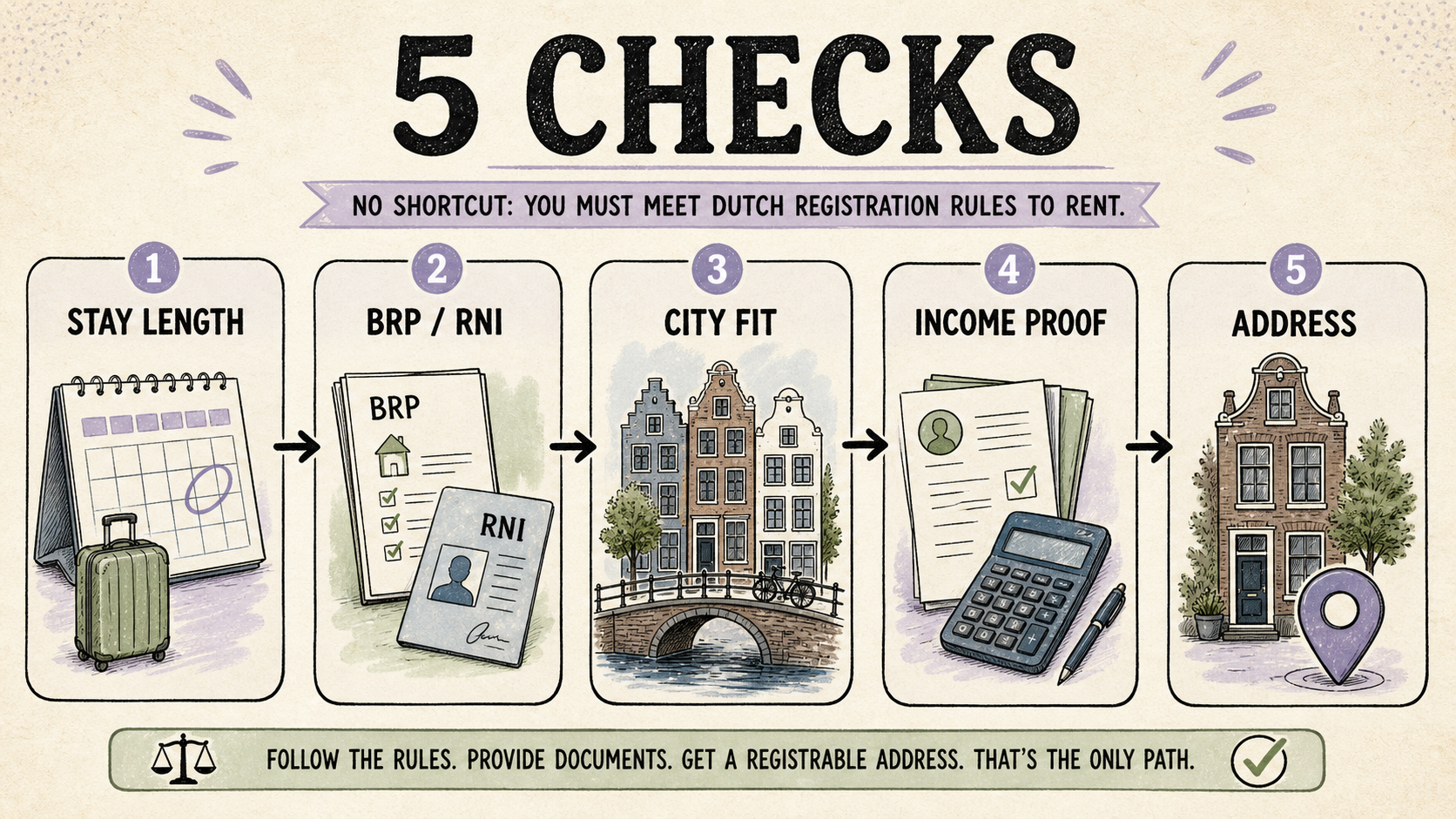
Choose your city with a five-step check
- Write down the stay route. Mark whether you expect BRP registration after a stay of more than four months, RNI registration for a shorter stay, or a different immigration route that needs professional confirmation.
- Set a complete monthly ceiling. Add rent, service costs, utilities, insurance, transport and furnishing. A €1,000 basic-rent target is not a €1,000 living-cost target.
- Choose two destination cities. Keep the work, study or family destination as the first constraint; do not chase a lower figure that makes the move unworkable.
- Ask the same address questions. Can you register at this exact address? What contract is offered? Who is the contracting party? Which documents are needed from an applicant who has no BSN yet?
- Verify before transferring money. Record the home in the rental options comparison and verify its address through the rental process before a deposit or service fee changes hands.
Frequently asked questions
Can I rent a home in the Netherlands without a BSN?
Sometimes a landlord or agent may accept an application before you have received a BSN, but acceptance is not a national right and does not settle your registration route. Verify the exact home, contract, address registration and residence conditions.
Which Dutch city is easiest without a BSN?
No city is universally easiest. Amsterdam, The Hague, Rotterdam, Utrecht and Eindhoven have strong newcomer ecosystems, while cities such as Enschede or Groningen can offer a different cost and competition profile. Your documents, income, timing and address matter more than the city label.
Do I need a BSN to sign a rental contract?
There is no simple city-wide answer. Landlords can set lawful screening requirements and may ask for identity, income and residence information. Ask the contracting party what it requires and whether registration at the address is allowed.
Can I register at a temporary or furnished address?
It depends on the address, contract and intended stay. A furnished or short-stay label is not proof that BRP registration is possible. Obtain the registration position in writing and confirm it with the relevant municipality when necessary.
Is RNI the same as BRP registration?
No. RNI is a non-resident registration route for people staying less than four months; BRP is the residents’ personal-records database used when someone lives in the Netherlands for more than four months. Both can provide a BSN, but they describe different situations.
Should I pay an agent before I have a viewing?
Be cautious. Confirm the agent’s identity, the home’s existence, the service scope and the fee basis first. The rental-agent selection for expats names the questions to ask, while scam signals expose pressure tactics and document requests.
A safer next step
Choose two cities that fit your actual destination and one fallback that fits your full budget. For each, verify the BSN or registration question against a real address, prepare only the relevant documents and compare the whole cost before you pay. A city shortlist is useful when it narrows a legal and practical decision; it is not a promise that a listing can bypass the rules.
A landlord's policy, your registration route and the city's support services answer different questions. Use this comparison to plan the search, then confirm whether the home can support your intended stay and registration.
Ask about renting before a BSN →