Common Mistakes When Renting as a Foreigner in the Netherlands
Avoid four common mistakes when renting in the Netherlands as a foreigner: mixing up BRP and RNI, oversharing documents, confusing status with approval and skipping contract checks.

Short version
Foreign renters tend to lose time or privacy in four places:
- treating BRP and RNI as interchangeable;
- sending a full document bundle before checking the recipient;
- treating a residence document or BSN as rental approval; and
- accepting a contract without checking the money, term and registration wording.
Slow the application down into four questions: Which stay applies? Which document supports this request? Who makes the decision? Which contract term am I accepting? The rental status for foreigners separates lawful stay, registration and rental approval.
Who should use these checks?
The checklist is useful when you are:
- arriving for work, study or a family move;
- applying before a Dutch BSN is available;
- dealing with a provider who uses unfamiliar Dutch terms; or
- asked to send identity, income or residence documents quickly.
It is equally useful for an EU renter and for someone whose stay requires an immigration document. The correct document changes with the situation; the habit of separating decisions does not.
Four mistakes to avoid
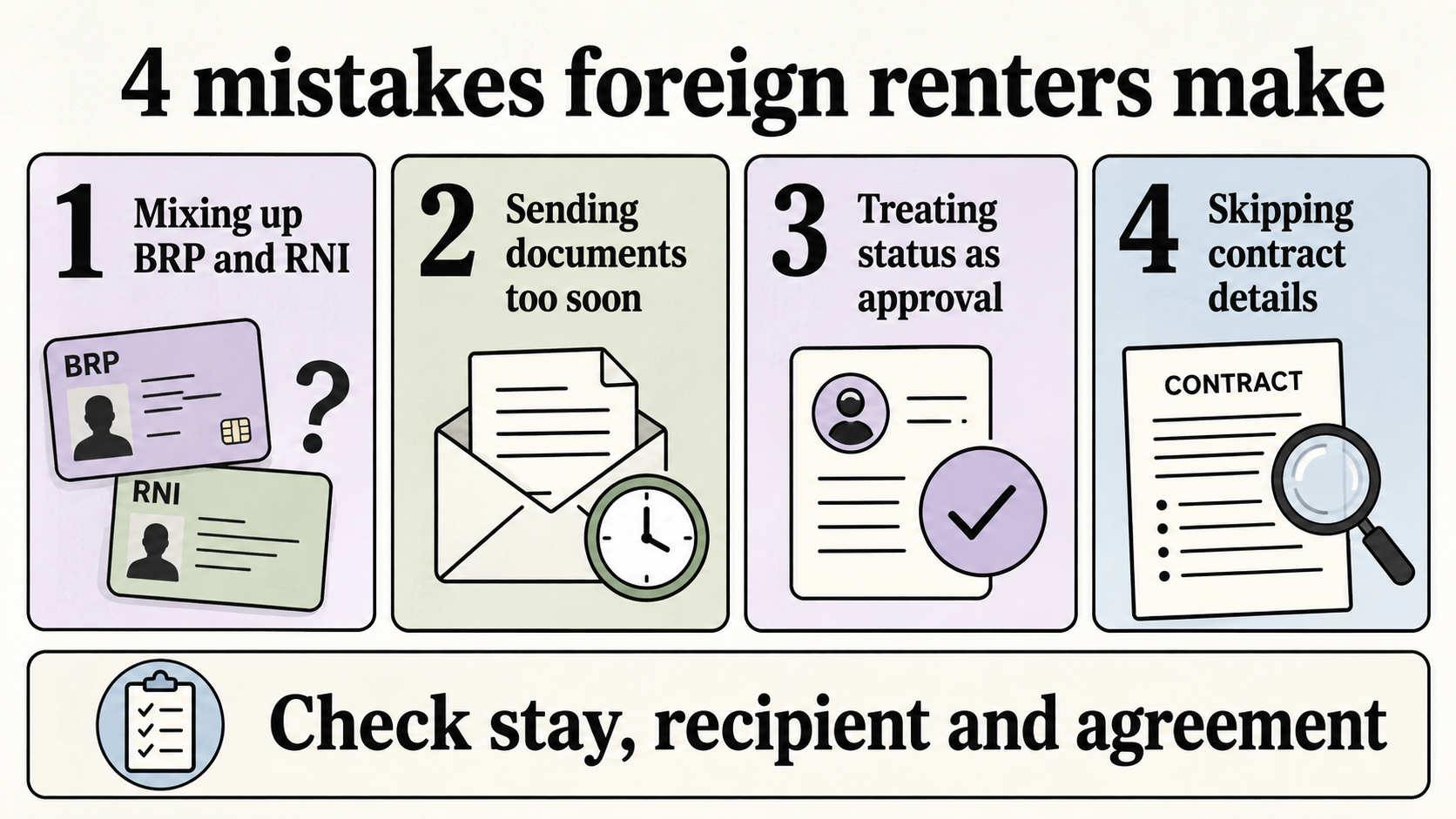
1. Mixing up BRP and RNI
BRP and RNI are both connected to the Dutch Personal Records Database, but they describe different positions. A planned stay of more than four months normally points to resident registration with the municipality. A shorter stay may fit non-resident registration through the RNI when its conditions are met.
The fix is simple: write down the expected length of stay, the municipality where you will live and the date you expect to arrive. Then ask whether the provider needs a registration plan, a BSN or another document for its own screening. A BSN and registration check separates a missing number from the timing and registration questions that surround it.
2. Sending documents too soon
A provider may need proof of identity, income or lawful stay. That does not mean every advertiser should receive an unredacted passport, bank statement or residence file at the first message. Sending a document before checking the recipient, purpose and transfer method creates privacy and fraud risks.
The fix is to ask three questions before sharing: What decision does this document support? Who receives it? How should I send it securely? Keep a record of the version sent and cover unnecessary numbers when the recipient permits it. A rental application review matches each document to a stated screening question.
3. Treating status as approval
A residence permit, passport or BSN can explain lawful stay or administration. It does not make a provider accept an application. Screening may still consider income, employment, study, household size, identity and the terms of the proposed agreement.
The fix is to separate the decisions in your notes. Under status, record the document and validity. Under registration, record BRP or RNI timing. Under rental approval, record the provider’s criteria and the missing evidence. This makes it easier to challenge an inaccurate statement without turning a provider’s preference into an immigration rule.
4. Skipping contract details
Speed matters in a competitive search, but the contract still determines the monthly commitment and the rights you will need to exercise. Check the initial base rent, recurring charges, deposit, start date, duration, notice, repairs, access and registration wording. A verbal promise about a BSN or registration cannot replace a clear written term.
The fix is to read the proposed agreement against the advert and your saved messages. Before signing, a rental contract review should cover rent, term, deposit, repairs and access. Keep the total rental cost separate from one-time costs and furnishing.
A safer application sequence
- Confirm the stay: note purpose, expected length and municipality.
- Confirm the recipient: check the provider, address and payment instructions.
- Match the file: send only documents that answer stated selection questions.
- Record the offer: save the advert, base rent, charges, deposit and contract date.
- Read before paying: compare the agreement, messages and payment request.
If any step changes, pause and record what changed. A new recipient, bank account or contract term deserves a fresh check rather than a quick reply.
Two examples
A student arriving for one semester
The student may plan a stay under four months or may cross the four-month marker depending on the programme and dates. Before sending a passport and enrolment letter, the student should ask which documents the provider needs, verify the payment recipient and confirm whether the room or home has a written contract.
An employee moving for a year
The employee’s six- or twelve-month plan points to the BRP question, while residence status and employer evidence remain separate. A work contract can support a rental application, but it does not replace the provider’s stated screening criteria or contract checks.
Neither example makes a decision for a particular person. The point is to keep the evidence attached to the right question.
After you submit the application
Keep a simple record of:
- documents and versions sent;
- recipient and sending date;
- provider criteria and unanswered questions;
- offer, contract and payment details; and
- promised registration or move-in actions.
If the recipient changes the payment account, asks for an unusual document or avoids a written agreement, the rental-scam check tests the warning signs before money moves.
Questions readers ask
Does a BSN mean that my application must be accepted?
No. A BSN is an administrative identifier, not a promise of housing. The provider can still apply its stated income, identity and contract checks.
Can an agent ask for a residence document?
It may be relevant to a provider’s file, but ask what decision it supports, who receives it and how it is stored. The request should not be treated as a substitute for checking the actual immigration rules.
Should I pay a deposit before receiving a contract?
Pause until the recipient, address, agreement and payment instructions are credible and consistent. A payment request that changes suddenly or avoids written terms deserves closer checking.
What if I cannot understand the Dutch contract?
Ask for a clear explanation of the terms before signing and compare the agreement with the advert. Keep the base rent, charges, deposit and registration wording visible while you review it.
Next step
A focused rental application review keeps each document connected to a clear question. If a provider’s request still feels mixed or unsafe, contact us through the form with the wording, stay length and step you are trying to complete.
A rushed application can expose sensitive documents or leave a key contract term unanswered. If a provider's request is unclear, send the exact wording through the contact form and we can help you identify the question behind it.
Ask about a rental application →