Common Mistakes With the Dutch Housing Shortage and Renters
Avoid common errors when reading Dutch housing-shortage figures, from mixing units and dates to treating a national estimate as a promise about one rental address.

Short version
The most common housing-shortage mistake is treating a national estimate as if it describes one rental address. CBS puts the Dutch 2025 shortfall at nearly 400,000 homes, or 4.8% of the housing stock. That number is a model estimate built from housing need and supply. It is not a count of applicants, a city ranking or a reason to skip checks on a listing.
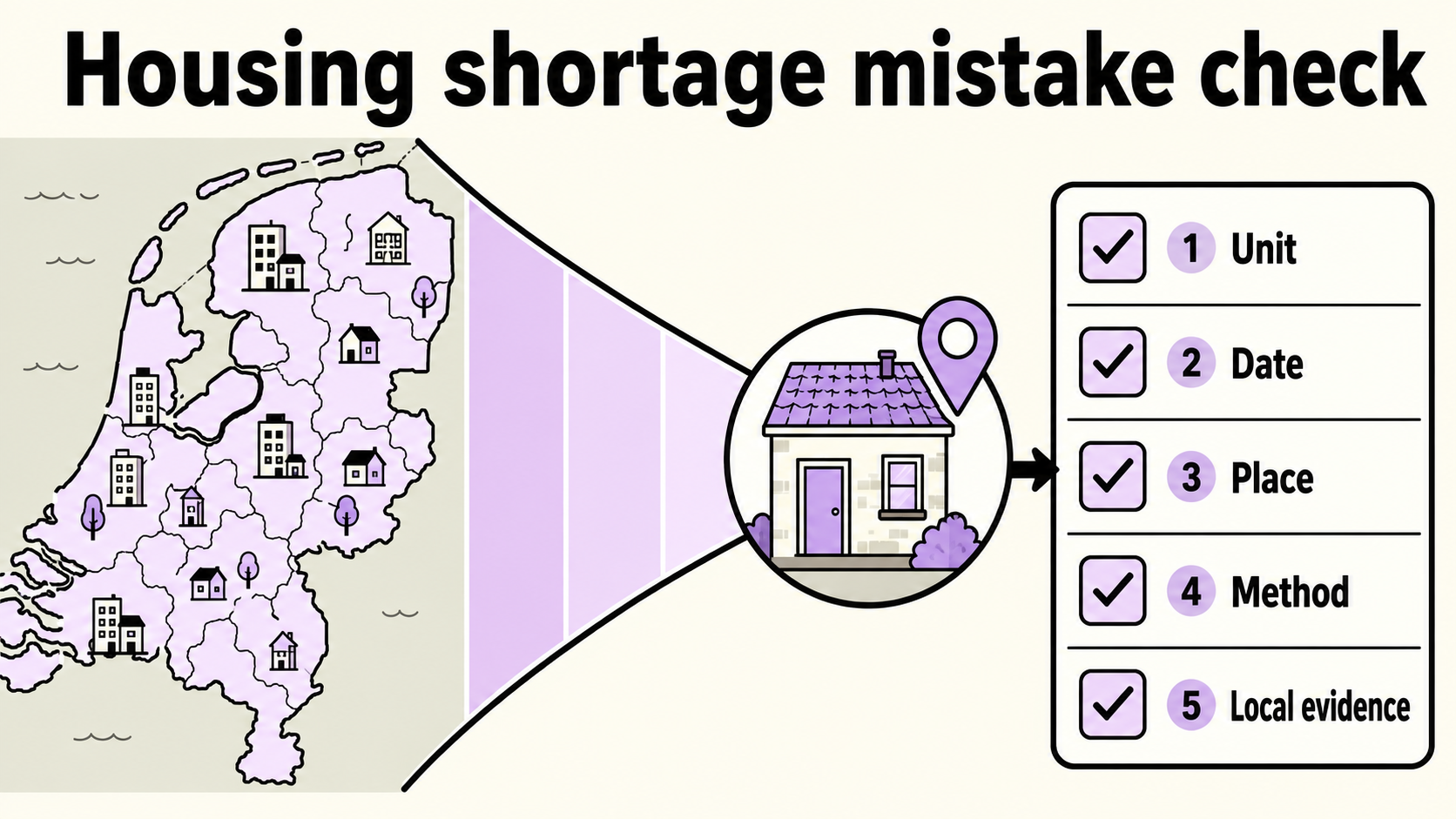
Before using a shortage claim, ask five questions: what is being counted, which date does it cover, what area does it describe, how was it calculated and what local evidence connects it to the home you are considering? Keep those questions tied to the Dutch housing-shortage definition, including its model boundary.
Mistake 1: confusing homes, households and applicants
“400,000 homes” and “400,000 people” are not interchangeable. A home is a unit in the housing stock. A household is a living arrangement with a housing need. An applicant is someone who responds to a particular offer. Each term answers a different question.
This distinction changes the decision. A national shortage estimate can show system pressure while saying nothing about how many people will apply for a two-bedroom home in Utrecht this week. A listing platform may show views or responses, but those figures do not turn into the CBS estimate.
Write the unit beside every number in your notes. If the unit is missing, do not compare it with a rent, a waiting list or an application count.
Mistake 2: dropping the year
A shortage number is tied to a period. CBS reports a 2025 model estimate, while a listing may be available for only a few days and a municipal waiting list may use another measurement period. Removing the year makes unlike observations look current and comparable.
The 2025 housing-shortage estimate should so stay attached to its year and definition. A renter comparing two cities should write down the period for each local source rather than place a national figure beside a current advert as if both were live counts.
Mistake 3: treating a national figure as local evidence
The Netherlands is not one rental market in the practical sense. A household searching in a city faces a particular mix of homes, prices, transport links, contract terms and providers. The national shortage can frame the pressure, but it cannot tell you whether a specific neighbourhood fits your budget or registration needs.
Use local evidence that matches the decision: current offers, municipal information, sector rules and the housing type you need. The Dutch rental market context keeps price, sector, supply and place in the same comparison.
Mistake 4: assuming more homes means the shortage disappeared
The housing stock grew by 70,000 homes on balance in 2025 and exceeded 8.3 million homes at the end of the year. Growth can occur alongside a shortage because households, household size, location and housing suitability also change.
The correct comparison is not “more homes or no shortage”. Ask whether the additional homes match the households that need them, are in the places being searched and are available in the relevant sector. A total count without type, date and location cannot answer that.
Mistake 5: using the shortage to excuse a weak listing
Competition can make a renter feel pressure to accept unclear information. A shortage statistic does not make an unknown provider trustworthy, an unexplained charge reasonable or an incomplete contract safe to sign.
Keep the rental application documents focused on the stated decision and protect unnecessary personal data. Save the advert, identify the provider, check the address and compare the agreement with the offer. Scarcity changes the pace of a search, not the standard for evidence.
A five-question correction
Apply this sequence when a headline, agent or post quotes the housing shortage:
- Unit: homes, households, listings, applicants or another measure?
- Date: which year, month or reference period?
- Place: Netherlands, province, municipality, neighbourhood or address?
- Method: model estimate, administrative count, survey, listing snapshot or waiting list?
- Local evidence: what current fact connects it to this home and this household?
If the answer changes halfway through the claim, split it into separate statements. That keeps a national model from doing the work of a local affordability or contract check.
Questions readers ask
Does a 4.8% shortage mean 4.8% of renters cannot find a home?
No. The percentage expresses a modelled shortage relative to the housing stock. It does not classify every renter or predict the result of one application.
Can the national estimate prove that a rent is too high?
No. Rent needs its own property, contract, sector and date checks. The total rental cost also includes recurring and one-time commitments that a shortage statistic does not measure.
Should I respond faster because the shortage is large?
Prepare a clear file and a realistic budget, but keep provider, address and contract checks in the process. Speed is useful only when the underlying offer is clear.
Next step
The housing-shortage impact on renters connects national pressure to competition and search trade-offs. If a claim still mixes a national estimate with one home, contact us through the form with the wording, date, place and question. Do not include personal documents.
A housing-shortage claim needs a unit, date, geography and method before it can guide a rental decision. If a figure is being used to justify a budget or contract choice, send the wording through the contact form and we can help you frame the question. Do not send passports, contracts, bank details or other personal documents.
Ask about a shortage claim →