How the Dutch Housing Shortage Affects Renters
See what the Dutch housing shortage means for renters through the 2025 estimate, rental-stock figures, competition, costs and practical search decisions.

Short version
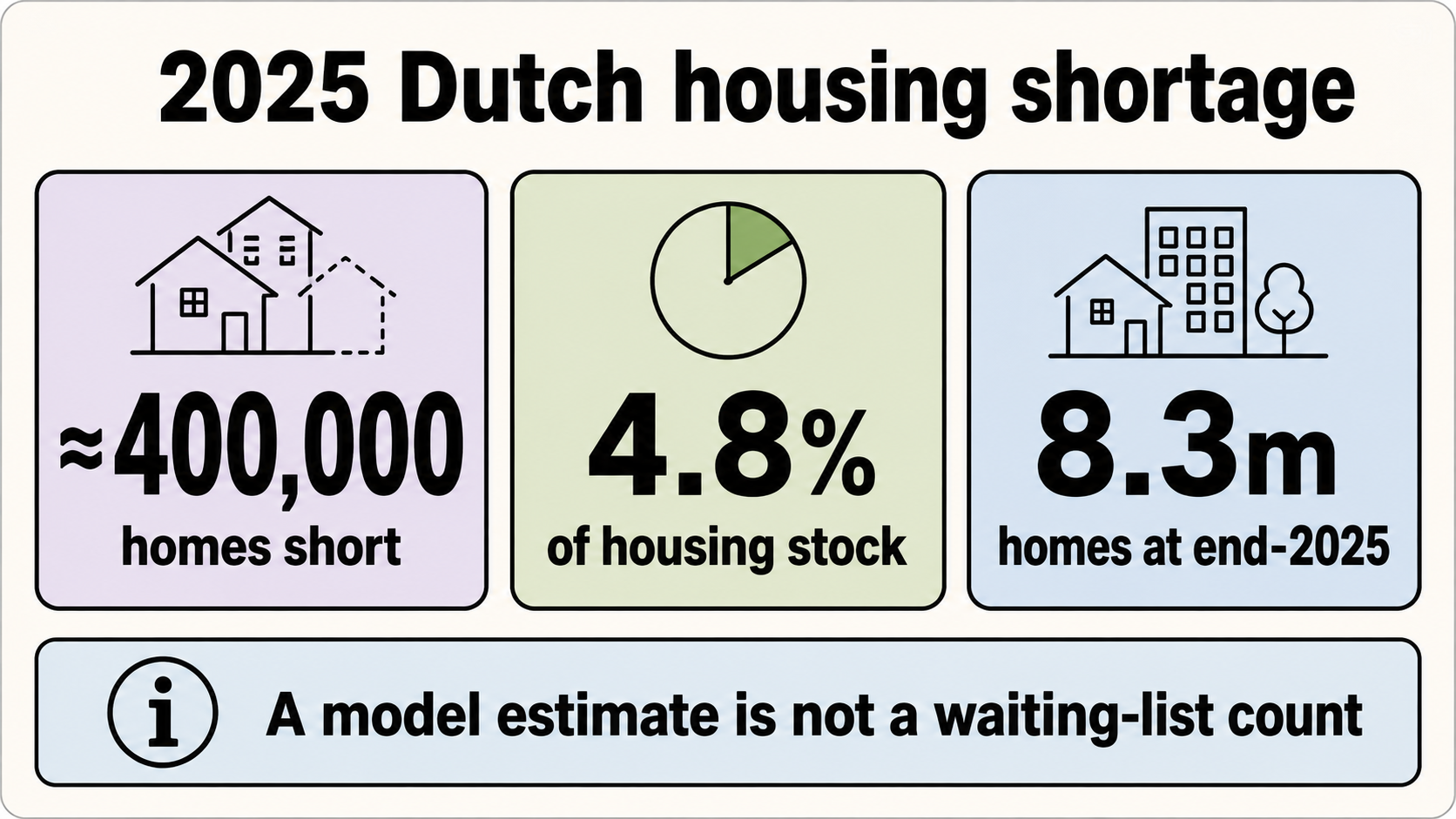
The Dutch housing shortage matters to renters because the number of households looking for suitable homes can grow faster than the homes available to them. CBS estimates that the 2025 shortfall was nearly 400,000 homes, equal to 4.8% of the housing stock. The Netherlands had more than 8.3 million homes at the end of 2025, so the percentage is a national model estimate rather than a count of people waiting for one advertised address.
For a renter, the practical effects are pressure on search time, competition, screening and trade-offs between price, place and space. Keep sector, price, supply, rules and place together with the Dutch rental market.
What the national figure tells you
The shortage estimate compares housing need and housing stock through a model. It says that the national system has fewer homes than the model considers necessary for households and living arrangements. It does not say that every city is short by the same percentage, that every vacant home is suitable or that every applicant faces the same competition.
Keep unit, date, place, method and local evidence separate with the housing-shortage mistake check; the housing-shortage questions identify what the 2025 figure measures and leaves out.
CBS also reports that the housing stock grew by 70,000 homes on balance in 2025. Growth and shortage can happen together: new homes add capacity, while household formation, moves and the need for different sizes or locations add demand. A positive construction figure is not proof that a specific renter will find a suitable home quickly.
How the pressure reaches a rental search
More competition for suitable homes
Shortage is about fit, not only the national total. A home may need to match a budget, household size, registration position, accessibility need, commute and contract term. A large national stock can still leave few suitable options in one price band and city.
That is why a renter benefits from a defined search: set the maximum total monthly cost, note acceptable locations, separate self-contained homes from rooms and keep a list of non-negotiable contract terms. The rental options comparison puts real offers under the same budget, space and contract headings.
Tighter screening and faster decisions
When many people respond to one home, a provider may ask applicants to submit a clear file quickly. Speed does not remove the need to check the recipient, selection wording or contract. A short response window can make a focused document file useful, while a request for every sensitive document deserves a privacy check.
A rental application review prepares a focused file for a competitive search. Keep each document connected to a stated decision and cover unnecessary numbers where the recipient permits it.
Greater pressure on monthly trade-offs
Competition can push a household to compare homes on headline rent alone. That is risky because service charges, utilities, travel, parking, furnishing and the deposit change the real commitment. A lower base rent can become expensive when a long commute or repeated temporary moves fill the gap.
Keep base rent, recurring charges and one-time costs separate with the total rental cost. Use the same categories for every offer so that shortage pressure does not turn into a rushed affordability decision.
A smaller private-rental stock in one period
CBS reported that the private rental sector had 3,000 fewer homes in 2024 than a year earlier, falling to 1.18 million homes. The change was linked to fewer privately owned homes even as homes owned by companies and other organisations increased. That is a stock movement across the country, not a measure of the number of homes a renter can see today.
The wider CBS rental-stock table reports 3,514,760 rental homes in 2025. “Rental stock” and “available listings” are different measures: a home can be occupied, under contract, temporarily unavailable or unsuitable for a particular household.
What the shortage does not prove
A shortage estimate does not prove that:
- a particular listing is genuine;
- an asking rent is fair or legally correct;
- every provider can demand the same document set;
- one city is always better for every renter; or
- a household should accept a contract without checking it.
A Dutch housing shortage clarifies why a model estimate is not a waiting-list count. Use the national number to understand pressure, then check the address and agreement in front of you.
A practical search framework
- Define the household: who will live there and what registration is needed?
- Set the total budget: include recurring and one-time costs, not only base rent.
- Set the evidence standard: save the advert, date, address and provider identity.
- Compare suitable options: use the same headings for price, space, travel and contract.
- Name the trade-off: decide whether a lower price, shorter commute or more space matters most.
- Pause at the contract: check term, deposit, repairs, access and registration wording.
This framework cannot create supply, but it can prevent a national shortage from making the decision vague.
Questions readers ask
Is the Dutch housing shortage 400,000 people?
No. The CBS figure is a model-based estimate of homes, not a headcount of people or a waiting-list total. The definition depends on households, housing stock and unmet demand.
Does the shortage mean rents must rise everywhere?
It creates pressure, but the effect differs by city, sector, housing type, contract and period. A national estimate cannot predict the lawful rent or full cost of one home.
Does building 70,000 homes solve the shortage?
Not by itself. The housing stock can grow while household numbers, moves and the need for particular locations or sizes also grow. Capacity, suitability and timing all matter.
How should a renter use the statistic?
Use it as context for competition and preparation. Then compare real offers, check the provider and read the agreement rather than treating the national figure as a reason to skip a question.
Next step
A Dutch housing shortage tests the relevant question when you need the terms, and the rental options comparison when you have real offers to compare. For a claim tied to one listing or household, contact us through the form with the figure, date, location and question.
A national shortage estimate explains pressure on the market, not whether one advert is genuine or one contract is affordable. If a statistic or listing claim is hard to interpret, send the wording through the contact form and we can help you frame the next question.
Ask about a housing-market claim →