Dutch Rental Market Overview
A practical map of the Dutch rental market: sectors, prices, supply, rules and place, with a method for reading a listing without confusing the signals.
Short version
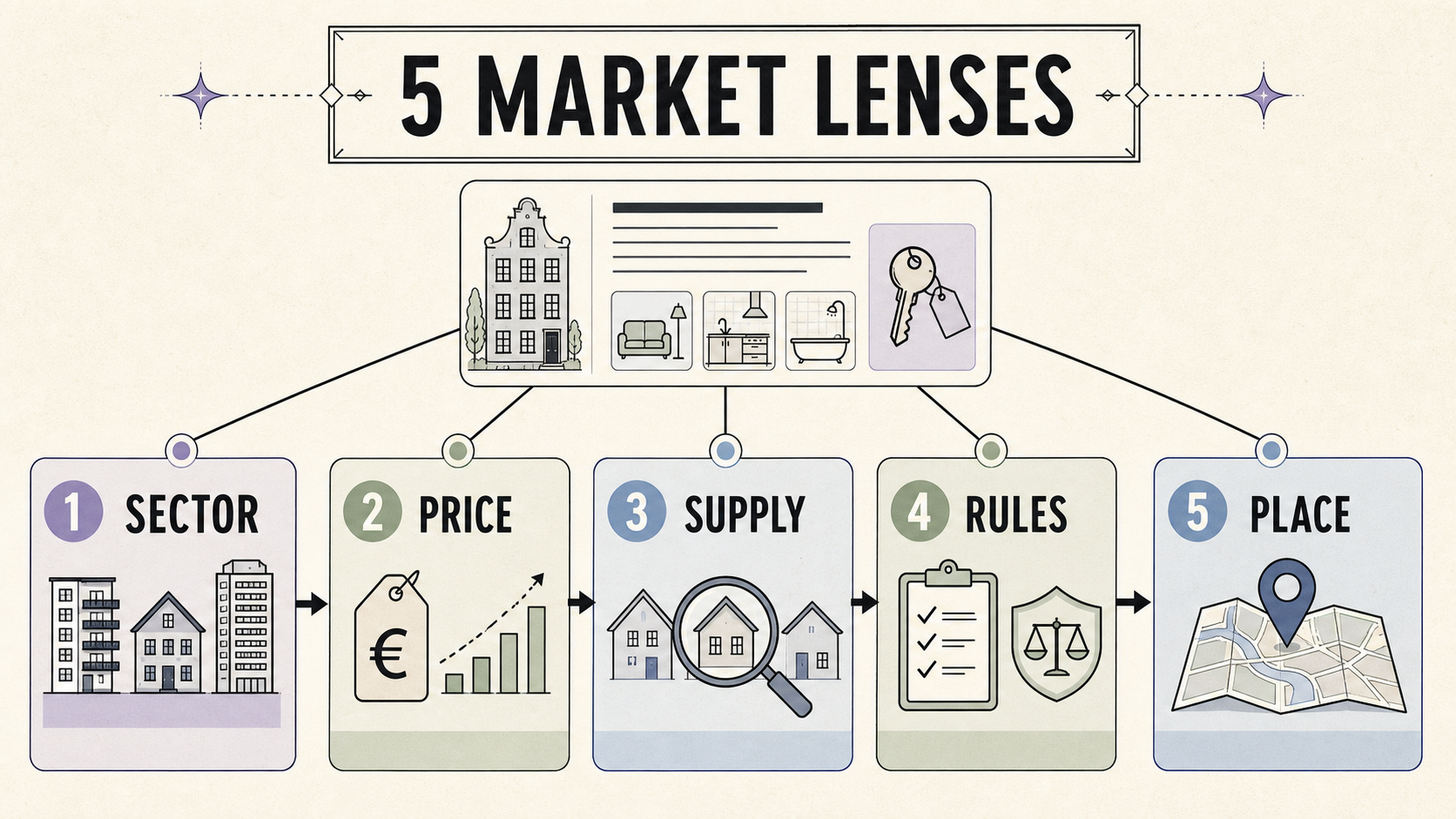
The Dutch rental market is easier to read as five connected lenses: sector, price, supply, rules and place. Sector tells you which rent and access framework may apply. Price separates base rent from the full monthly commitment. Supply describes what is available in a defined search, not what one advert guarantees. Rules cover contracts, rent assessment, deposits, service charges and registration. Place changes travel, local allocation and the practical value of a home.
The map is useful only when you return to the address, agreement date and household in front of you. The rental basics sets out the terms, while the rental options comparison records two real offers under the same headings.
What the Dutch rental market includes
Government.nl groups rented housing into social, midprice and private non-subsidised contexts. The same guidance describes rules for both tenant and landlord covering security of tenure, rent, increases, maintenance and service charges. Shared accommodation is a further practical distinction because rooms have shared facilities and their own rent-assessment process.
These are not three building styles. A self-contained apartment can be social, mid-price or private depending on the relevant rent and points framework. A room can be regulated while still being a shared-accommodation arrangement. A distinction between self-contained homes, rooms and social housing clarifies how the labels overlap.
Five market lenses
The infographic gives a quick visual index for reading a claim or listing.
Rules connect the market to decisions. A written tenancy agreement should identify the parties, address, rent and relevant conditions. Government guidance also covers deposits, service costs, rent increases, maintenance, access and the process for unresolved problems. A points result may be useful, but the Rent Check result can differ from an official assessment because measurements or answers can differ.
1. Sector
Start with the physical accommodation and the agreement start date. For a self-contained agreement beginning in 2026, Government.nl uses an initial base rent up to €932.93 for social housing. The midprice band runs above €932.93 to €1,228.07 with 144 through 186 points, while the private-sector threshold is above €1,228.07 and at least 187 points. Use these as date-specific orientation markers, not as a conclusion from the advertised total.
For a room or another shared accommodation, the physical facilities and the applicable points system change the process. The Huurcommissie Rent Check distinguishes the self-contained and shared routes.
2. Price
Price has at least three layers: initial base rent, recurring monthly charges and one-time move-in costs. Keep service charges, utilities, insurance, travel, parking, internet, furniture and deposit separate. If you combine them too early, it becomes impossible to tell whether a higher figure comes from the home, the contract or your routine.
For a transparent planning example, €950 base rent + €200 stated monthly charges = €1,150 before a deposit, moving costs or furnishing. The formula is simple enough to reproduce, but the figures are illustrative and say nothing about the average market.
3. Supply
Supply is a defined observation, not a promise. A search for homes under a particular budget, in one city, for one household and during one week describes a different pool from a national headline. When you see a supply claim, ask for the period, geography, housing type, source and whether it counts listings, homes or completed agreements.
An advert proves that one offer was presented. It does not prove how many similar homes exist, how quickly they are allocated or how many applicants compete for it. Use a market statistic as context, then verify the offer itself.
4. Rules
Rules connect the market to decisions. A written tenancy agreement should identify the parties, address, rent and relevant conditions. Government guidance also covers deposits, service costs, rent increases, maintenance, access and the process for unresolved problems. A points result may be useful, but the Rent Check result can differ from an official assessment because measurements or answers can differ.
Registration is another rules lens. Government.nl says a person living in the Netherlands for longer than four months must register as a resident, generally within five days of arrival. The address and expected stay still need to be checked with the municipality.
5. Place
Place changes more than the postcode. Compare the address with the commute, local transport, daily services, energy profile, neighbourhood fit and any provider or municipal conditions. A lower base rent can lose its advantage when travel or furnishing adds a recurring burden. Conversely, a more expensive home can be practical if it removes a large routine cost—but that is a household calculation, not a market ranking.
How to read a listing with the five lenses
- Save the evidence: copy the advert, date, address and stated terms.
- Classify the space: record whether entrance, kitchen, toilet and bathroom are private or shared.
- Separate the money: write base rent, each recurring charge, deposit and one-time costs on separate lines.
- Check the rules: record agreement date, points information, term, repairs, access and registration wording.
- Test the place: compare travel, routine and household needs rather than the headline city name.
- Name the unknown: ask one precise question before sending money or a full document file.
What the market overview cannot tell you
A national label cannot decide the quality of a particular home. A city-level average cannot tell you the full cost of one contract. A provider’s general policy cannot confirm eligibility for one household. A market headline also cannot confirm that a listing is genuine. A staged rental document set and a rental contract review keep document sharing and contract signing in the right order before you commit.
Questions readers ask
Is the Dutch rental market only the private sector?
No. Government.nl describes social, midprice and private non-subsidised housing, and shared accommodation has its own practical facility and rent questions. Keep the sector name and physical housing type separate.
Is €1,228.07 the maximum rent in the Netherlands?
No. It is a 2026 initial-rent marker used in the sector framework for agreements that start in 2026. The outcome also depends on the accommodation, points, agreement date and applicable rules.
Does more supply always mean an easier application?
Not necessarily. “Supply” depends on how it was measured, and an individual offer can still have strict provider conditions or many applicants. Ask for the period and method before using a supply claim in a decision.
Should I compare city averages or real listings first?
Use a defined market signal for orientation, then compare real listings under the same full-cost and contract headings. The rental options comparison is designed for that second step.
Next step
The Dutch rental market clarifies the term, while the free-sector versus regulated-rent distinction tests the listing’s sector label. The Dutch housing shortage measures households, stock and unmet demand, while the housing-shortage impact translates that pressure into competition and costs. The distinction between self-contained homes, rooms and social housing helps when the choice is between a self-contained home, room and social option. If a market claim or listing still feels incomplete, contact us through the form with the source wording, date, location and question.
A market overview can orient you, but it cannot decide whether one address, contract or price is suitable. If you want to unpack a market claim or listing detail, send the wording through the contact form and we can help you identify the next check.
Ask about a market claim →