What Is The Dutch Rental Market?
A plain-language definition of the Dutch rental market and the four facts—sector, rent, home and contract—that make the term useful to renters.

Short version
The Dutch rental market is the system in which homes and rooms are offered to tenants under different price, contract, access and registration conditions. It is not one national price or one list of available homes. For a renter, the useful definition has four working terms: sector, rent, home and contract.
Use the phrase for context, then return to the address and agreement in front of you. The Dutch rental market expands the five-lens context, while the definition stays focused on the four main terms.
A definition you can use
The Dutch rental market is the network of rental homes, rooms, landlords, housing associations, tenants, price rules and public processes that determine what can be offered, to whom and under which agreement. A market statement needs a period, place, housing type and measure before it can guide a decision.
That last sentence is the relevant boundary. “Rents are rising” is incomplete without saying which rent, where, over what period and whether the figure is an asking rent, an initial contract rent or a regulated maximum. “Supply is tight” also needs a defined count and geography.
Four market terms
The body infographic puts the four terms beside the listing they help explain.
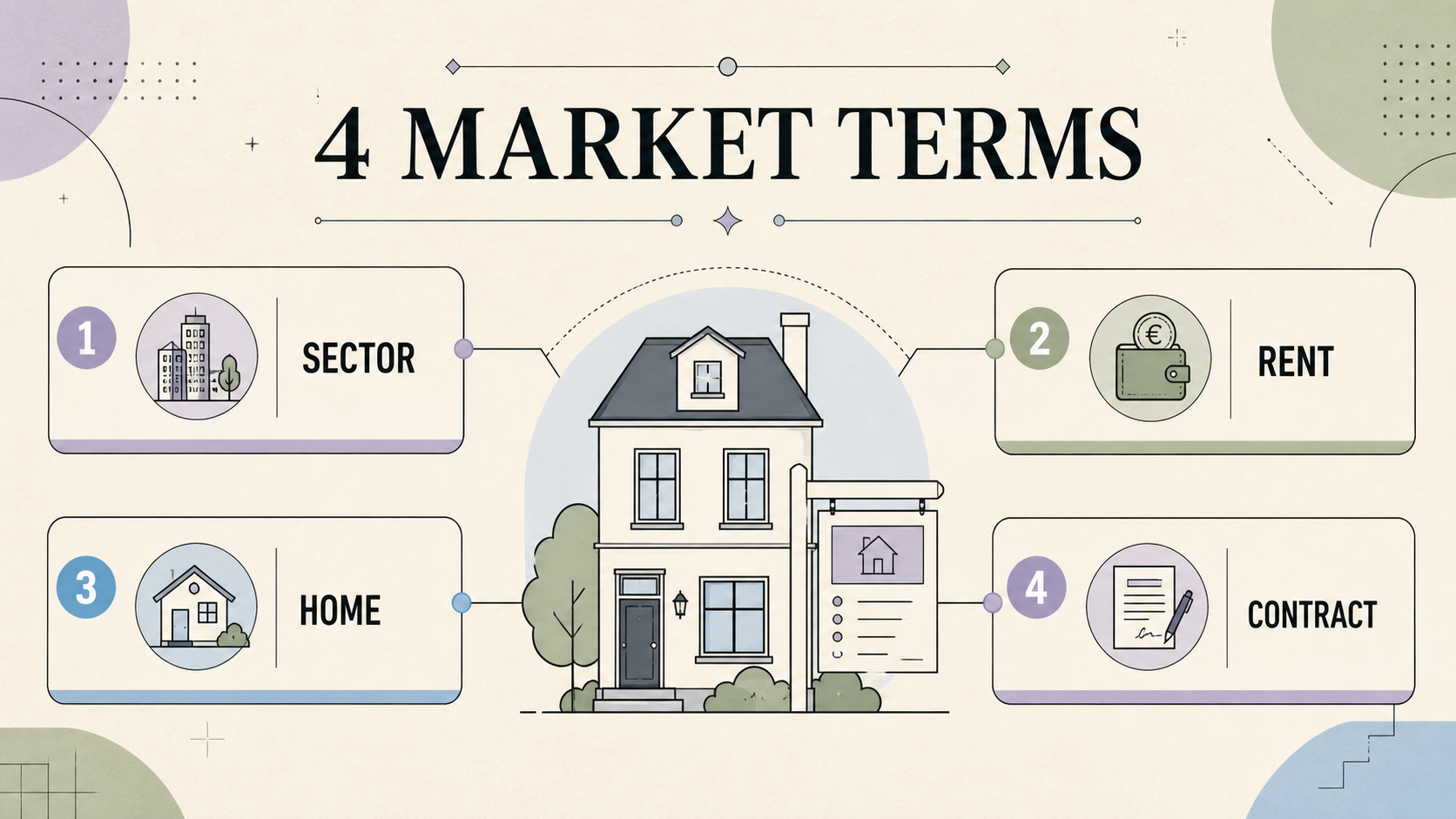
1. Sector
Sector is the rent and access framework that applies to an accommodation and agreement. Government.nl describes social, midprice and private non-subsidised rental contexts. For a self-contained agreement starting in 2026, the orientation markers are up to €932.93 for the social initial-rent limit, above €932.93 to €1,228.07 for the middle band with the relevant points range, and above €1,228.07 with at least 187 points for the private-sector threshold.
The markers are tied to the agreement start date and the applicable property assessment. Do not decide the sector from the total including utilities or from a marketing adjective.
2. Rent
Rent means more than the first number in an advert. Keep the initial base rent separate from service charges, utilities, insurance, travel, parking, internet, furniture and the deposit. The Huurcommissie Rent Check uses the home’s quality and facilities to calculate points and a maximum base rent for the relevant process.
As a simple comparison, €950 base rent plus €200 recurring charges gives €1,150 before one-time costs. The formula is €950 + €200 = €1,150; the figures illustrate the method and are not a claim about the Dutch average.
3. Home
Home is the physical accommodation and the way it is used. A self-contained home has its own entrance, kitchen, toilet and bathroom or washing facilities in the Huurcommissie orientation test. A room can have a private bedroom while sharing one or more of those facilities.
“Own home”, “studio” and “apartment” are not substitutes for the facility questions. A distinction between self-contained homes, rooms and social housing tests the relevant question when a listing mixes room, own-home and social language.
4. Contract
The contract is the written relationship that turns an offer into a tenancy. Check the parties, address, term, base rent, other charges, deposit, annual increase, repairs, access, house rules, handover and registration wording. Government.nl says tenancy agreements dated 1 July 2023 onwards should be in writing and relevant information about rights and duties must be provided.
The contract cannot override every public rule, and a chat message cannot replace a missing term. Before signing, a rental contract review should put rent, charges, term and repair duties beside the signature.
Examples and misconceptions
“A market price tells me what I should pay”
A market figure can be context, but it may describe a different home, place, period or rent measure. Compare the real offer’s base rent, costs, facilities and points rather than using a national number as a verdict.
“Social housing means a small apartment”
Social housing is a rent and access context, not a floor-plan description. A social home can be self-contained. A room can also be regulated while sharing facilities.
“The city name is the market”
A city contains different neighbourhoods, housing types, providers, transport patterns and price frameworks. Place is one term in the definition, not a complete decision rule.
How to apply the definition
- Copy the advert and date it.
- Mark the facilities private, shared or unknown.
- Write the base rent and every recurring charge on separate lines.
- Record the agreement date, term, points information and provider conditions.
- Check the address and expected stay with the municipality if registration matters. Government.nl says stays longer than four months generally require BRP registration within five days of arrival.
- Compare the offer with another using the rental options comparison.
Questions readers ask
Is the Dutch rental market the same as the housing market?
No. The housing market can include buying, building and other tenure forms. The rental market focuses on homes or rooms offered to tenants under a tenancy relationship.
Does the definition tell me whether a home is affordable?
No. Affordability depends on household income, full monthly costs, savings, travel and other obligations. A rental-cost breakdown separates actual figures into recurring and one-off amounts.
Can a room be part of the Dutch rental market?
Yes. A room is a rental accommodation with shared-facility questions and a relevant rent-assessment process. It is not automatically equivalent to a self-contained home.
What is the first term to check in a listing?
Check “home” first by asking which facilities are private. Then check sector, rent and contract. That order prevents a price label from masking a different accommodation type.
Next step
The Dutch rental market supplies the five-lens framework, while the free-sector and social-housing framework separates those labels. The distinction between self-contained homes, rooms and social housing separates the housing routes by facilities and rent framework. If a market phrase in a listing still leaves the four terms unclear, contact us through the form with the wording, address area, date and question.
“The Dutch rental market” is a broad term, while a rental decision is about one address, household and agreement. If a market statement or advert does not show which fact it relies on, send the wording through the contact form and we can help you frame a useful follow-up question.
Ask about a market term →