FAQ: The Dutch Rental Market in the Netherlands
Answers to practical questions about Dutch rental sectors, prices, supply, contracts, registration and how to test a market claim.

Short version
The five questions that make a Dutch rental-market answer useful are: which sector, which price, what supply, which contract, and can the household register? A market overview can set context, but it cannot substitute for the address, agreement, household and municipality in a real decision.
Quick navigation
- Which sector is this?
- Which price is being discussed?
- What does supply mean?
- Which contract rules matter?
- Can the household register?
How to These answers fit this rental search
Copy the claim or advert wording and add its date, place, housing type and source. Then separate the five lenses with the Dutch rental market and test whether the claim has a definition, date and place with the Dutch rental-market mistake check.
Use the infographic as a visual index: each question points to a different fact to verify.
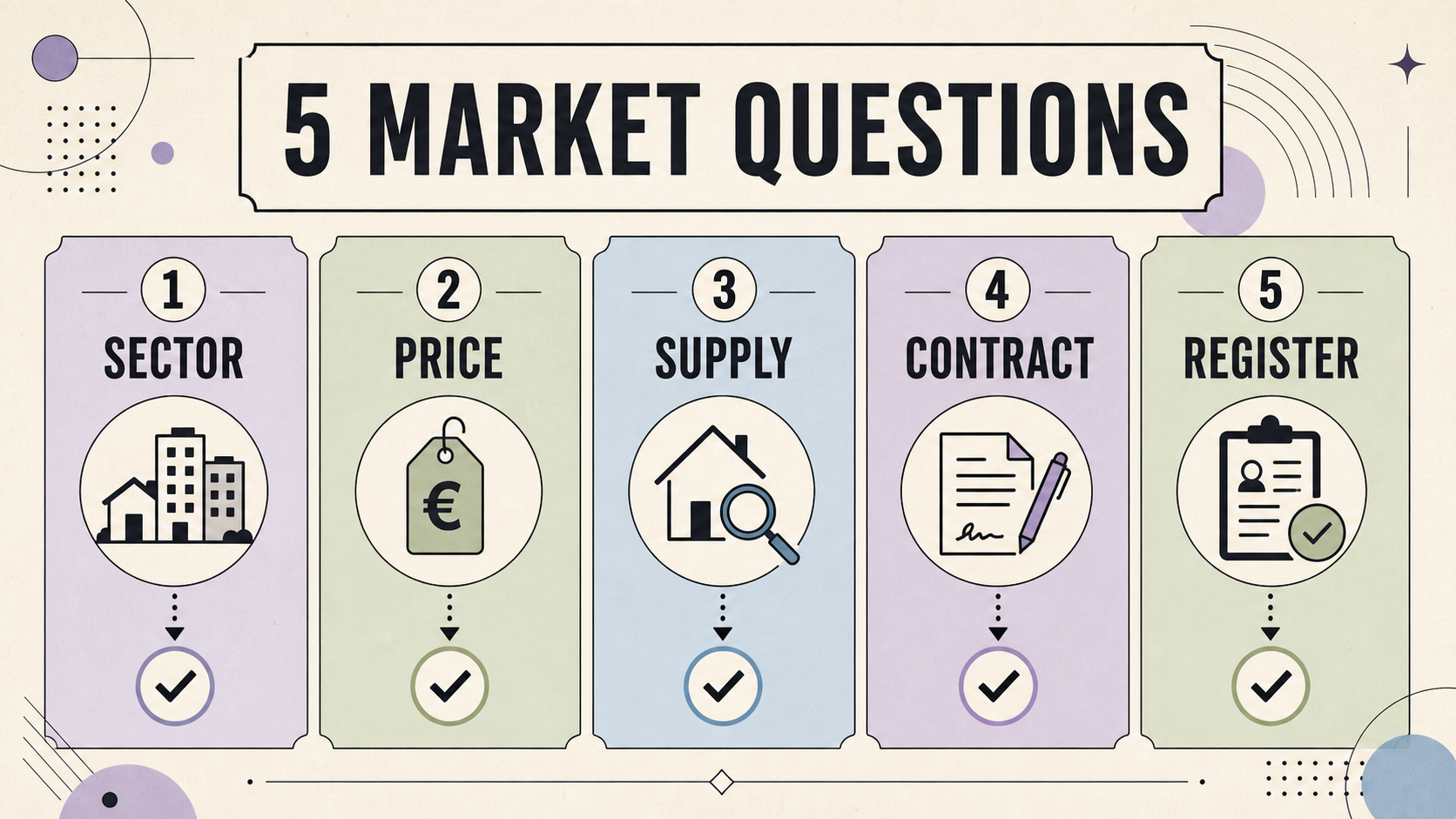
Which sector is this? {#which-sector-is-this}
What are the main Dutch rental sectors?
Short version: Government.nl describes social, midprice and private non-subsidised rental contexts; shared accommodation adds a separate facility and rent-assessment question.
Detailed answer: Sector is not a synonym for house style. For a self-contained agreement starting in 2026, official orientation markers are an initial base rent up to €932.93 for social housing and above €1,228.07 for the private-sector threshold. The middle band above €932.93 to €1,228.07 also depends on the relevant quality-points range. Check the agreement date and property details before using the figures.
Does a social home have to be a room or small apartment?
Short version: No. Social describes a regulated rent and access context, not the floor plan.
Detailed answer: A self-contained home can be social housing. A room can be regulated while sharing facilities. Ask whether the entrance, kitchen, toilet and bathroom are private or shared, then check the provider and rent rules separately.
Does an advertised total classify the sector?
Short version: No. Use the initial base rent, not a combined total, and include the agreement date and points where relevant.
Detailed answer: Record base rent, service charges and utilities separately. A precise-looking all-in number can hide which amount is used for sector classification. A Huurcommissie Rent Check covers the property-specific process.
Which price is being discussed? {#which-price-is-being-discussed}
Is a market rent the same as the full monthly cost?
Short version: No. Base rent is one line in a household budget.
Detailed answer: Add recurring charges, utilities, insurance, internet, travel, parking and furnishing as separate lines. For a transparent illustration, €950 base rent + €200 recurring charges = €1,150 before one-time costs. The numbers demonstrate the method; they are not an average.
Is a market average a fair price for one home?
Short version: Not by itself. The average may describe a different period, city, home type or rent measure.
Detailed answer: Ask what is counted and whether the figure is an asking rent, initial rent, full cost or regulated maximum. Then compare the actual home’s facilities, points, contract and recurring charges. A rental-cost breakdown keeps the measures separate.
What is the 2026 private-sector threshold?
Short version: For self-contained agreements beginning in 2026, Government.nl describes €1,228.07 as the current initial-rent threshold for liberalised private-sector rental, with the relevant points condition.
Detailed answer: This is a date-specific sector marker, not a universal monthly budget or a maximum for every agreement. Record the agreement start date, initial base rent, home type and points before drawing a conclusion.
What does supply mean? {#what-does-supply-mean}
Does more supply mean an easier application?
Short version: Not automatically. Supply depends on the period, geography, home type, budget, eligibility and counting method.
Detailed answer: A national number can include homes your household cannot apply for. Ask whether the count is listings, homes, available units at a moment or completed agreements, then compare it with the search you can actually access.
How should I read a city or national ranking?
Short version: Treat it as a starting point, not a decision.
Detailed answer: Check the criteria, data period, sample and household assumptions. A ranking can hide differences in transport, contract terms, full costs, registration and provider access. Put real addresses through the rental options comparison.
Which contract rules matter? {#which-contract-rules-matter}
What should I check in a Dutch rental contract?
Short version: Check the parties, address, term, base rent, charges, deposit, repairs, access, house rules and handover.
Detailed answer: Government.nl says tenancy agreements dated 1 July 2023 onwards should be in writing and information about rights and duties must be provided. A market headline cannot answer what your agreement says. A rental contract review is useful before signing.
Can a market label replace the written agreement?
Short version: No. “Social”, “private” or “all-in” language does not fill in a missing duration, charge or repair term.
Detailed answer: Ask for an explicit written answer and compare it with the contract. Keep the advert and replies dated so you can identify what changed.
Can the household register? {#can-the-household-register}
Does a rental advert decide BRP registration?
Short version: No. The address, expected stay and municipal process decide the registration question.
Detailed answer: Government.nl says someone living in the Netherlands for longer than four months must register as a resident, generally within five days of arrival. A stay under four months can involve non-resident registration. Ask the municipality about the address and keep proof of occupancy. A BSN and registration check clarifies the distinction.
Can room renters register?
Short version: Not every room arrangement answers the same way; check the address, occupancy and municipal requirements.
Detailed answer: Shared facilities identify a room-rental arrangement, but they do not by themselves decide BRP registration. Ask what address can be used and which occupancy evidence is available before relying on a promise in a listing.
Questions that need a closer review
What if the source and the provider disagree?
Keep the source, advert, agreement and written replies together. Ask which fact each statement relies on and use the relevant official process for rent, contract or registration questions. If the issue affects a payment or signature, pause until you understand the difference.
What if the market answer feels too general?
Add the missing frame: date, geography, home type, household, price measure and source. Then ask one specific question rather than trying to solve a whole market from one sentence.
Next step
Name the four main terms with Dutch rental market; when the issue is a rent segment, the questions about free-sector and social housing keep the categories distinct. Keep a five-lens comparison beside the claim with the Dutch rental market. If a statistic or listing still leaves a unresolved fact unclear, contact us through the form with the exact wording and what decision it affects.
A rental-market answer is useful only when its period, home type, price measure and source are clear. If your question is tied to one listing or an unclear statistic, send the wording through the contact form and we can help you identify the next fact to verify.
Ask a market question →