FAQ: Renting Your Own Home in the Netherlands
Get clear answers about self-contained homes, rooms, rent sectors, deposits, documents, BSN registration and the full cost of renting.

Short version
Renting your own home means using a defined dwelling as a tenant under agreed terms. The most useful answer to a rental question comes from the home, contract, money and proof in front of you. The FAQ below points to the next fact to check rather than guessing from a listing label.
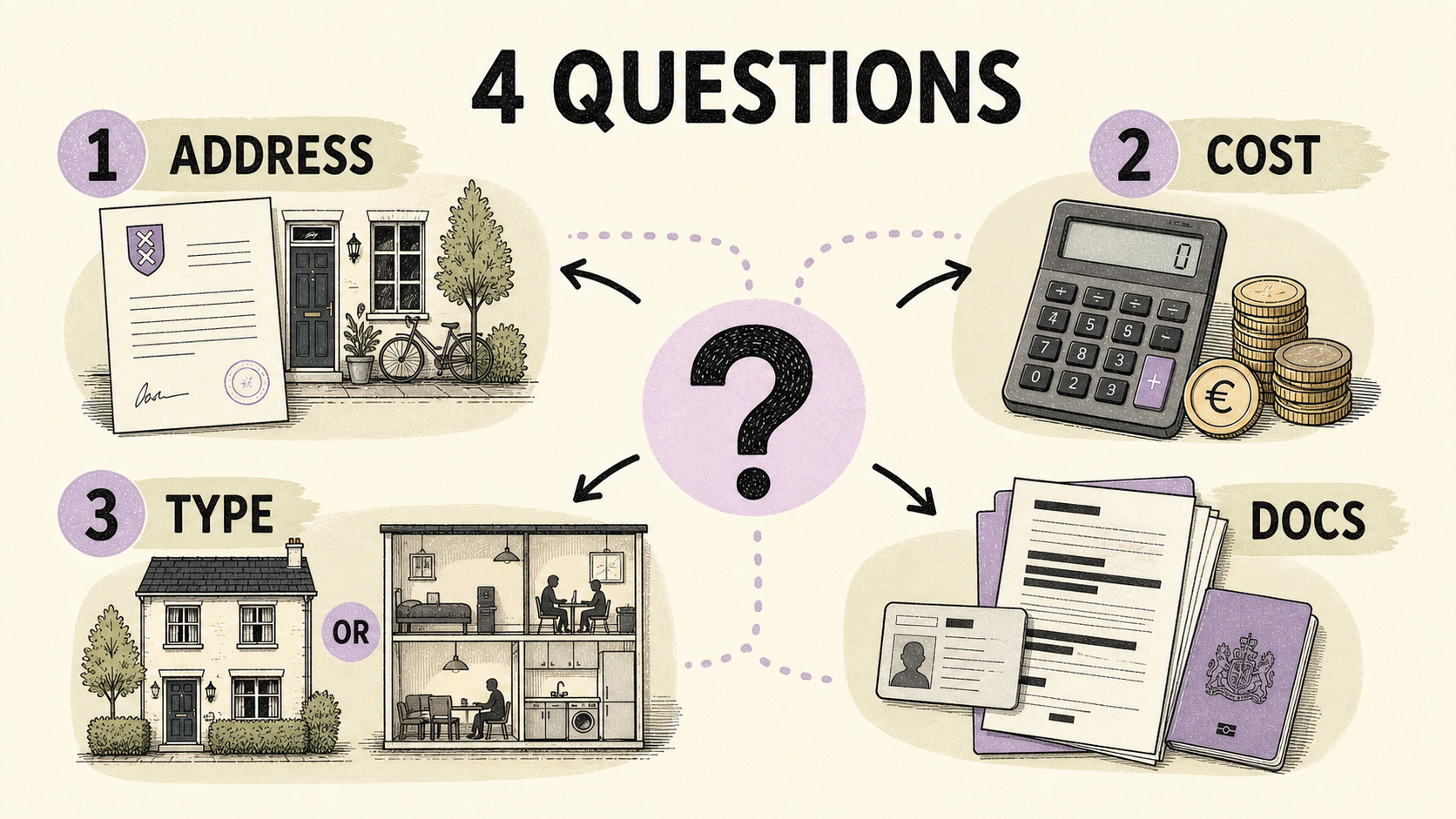
An advert should answer four separate questions—home type, contract, budget and proof—so the meaning of renting your own home supplies the local definition before you assess the offer.
Quick navigation
- Home and housing type
- Contract and money
- Application and registration
- Questions that need a closer review
How to These answers fit this rental search
For each question, write down the property address, date, housing type, amount and contract stage. Then find the document or organisation that can confirm the answer. A landlord can explain an agreement. The municipality handles registration. Huurcommissie information helps with rent assessment and housing facilities.
Home and housing type
Is renting your own home the same as buying one?
No. Renting gives a household the right to use a dwelling for the agreed period. The landlord keeps ownership. Buying gives the buyer an ownership interest. The phrase “your own home” describes where you live and the private use you receive.
What makes a rental home self-contained?
Huurcommissie’s Rent Check describes a self-contained home through its own entrance, kitchen, toilet and bathroom. Ask who uses each facility. An advert’s words “studio” or “private apartment” need a floor-plan and viewing check.
Is a rented room a home?
A room can be your home in everyday language. Shared kitchen, toilet or bathroom facilities place the question in the room-rental category for housing and rent assessment. When an advert combines labels, the distinction between self-contained homes, rooms and social housing separates facilities, agreement and rent framework.
Can a self-contained home also be social housing?
Yes. “Self-contained” describes facilities. “Social”, “mid-price” and “private” describe a rent-sector position based on factors such as initial rent, points and agreement date. One home can fit more than one description.
Contract and money
What should a rental agreement show?
Check the parties, address, base rent, other charges, deposit, start date, duration, notice terms, repairs, access, house rules, inventory and signatures. Ask for missing terms before signing. Since 1 July 2023, government information has required a written agreement and information about tenant rights and duties.
A rental contract review sets out a reading order and points out questions that deserve a written answer.
Which 2026 rent sectors should I know?
For self-contained homes under agreements starting in 2026, government guidance uses these markers:
- Social rental: initial base rent up to €932.93.
- Mid-price rental: initial base rent above €932.93 up to €1,228.07, with 144 to 186 points.
- Private rental: initial base rent above €1,228.07 and at least 187 points.
The points position, initial rent, home type and agreement date still need a check. A headline sector label cannot settle every question about a contract.
How high may the deposit be?
For agreements starting on or after 1 July 2023, the government says the deposit may be at most two months of base rent. The landlord generally returns it within 14 days when no deductions apply and within 30 days when deductions are made. Read the current agreement and official guidance for the exact situation.
Are service charges part of the rent?
Keep base rent and service charges as separate lines. A landlord may charge actual service costs connected to the tenancy and should explain the calculation. Ask whether an amount is an advance and when the annual settlement will arrive. Add utilities arranged by the household as separate costs.
What is the full cost of renting?
The full cost can include base rent, service charges, utilities, insurance, travel, parking, internet, furnishing and one-time move-in costs. A rental-cost breakdown sets out a budget structure. A rental options comparison covers the same headings across two homes.
Application and registration
Can I apply before I receive a BSN?
Some renters can apply before receiving a BSN. The landlord’s selection process, your expected stay and the municipality’s registration rules remain separate questions. If you expect to live in the Netherlands for more than four months, resident registration generally applies. A stay under four months can fit the non-resident system. A BSN and registration check separates the landlord’s application policy from the municipality’s registration process.
Which documents can a landlord request?
The request can cover identity, income, work, household and current housing, depending on the stated criteria and application stage. Ask why each item is needed, who receives it, how it is stored and whether a redacted copy works. Keep the evidence in stages with the rental document set.
What should I do with an unclear payment request?
Pause. Save the advert, ask who owns or manages the home, request written terms and verify the viewing and payment reason. Do not let a deadline remove the questions that protect your money and privacy. The rental-scam check lists warning signs.
Who decides whether I can register?
The municipality decides registration requirements for the address and expected stay. The landlord can state what the agreement says and whether the provider permits registration. Keep both answers in writing and ask the municipality which evidence and timing apply.
Questions that need a closer review
General information can orient a decision. A dispute, unusual clause, suspected discrimination, rent-assessment deadline or registration problem needs the relevant official body or a qualified professional. Keep the dates, agreement, advert, payment proof and messages together so the question can be assessed from evidence.
Next step
Choose the question closest to your situation and collect the evidence named in the answer. If one fact remains unclear, use the contact form with the address area, housing type, date and exact wording of the question.
A question about a Dutch rental becomes easier to answer when it includes the home type, contract stage, amount, date and missing evidence. If an advert or agreement leaves one of those facts open, send us the wording and your question through the contact form.
Ask a rental question →