FAQ: Renting Your Own Home, Room-Renting and Social Housing in the Netherlands
Get direct answers about self-contained homes, room-renting, social housing, 2026 rent markers, costs, documents, contracts and registration.

Short version
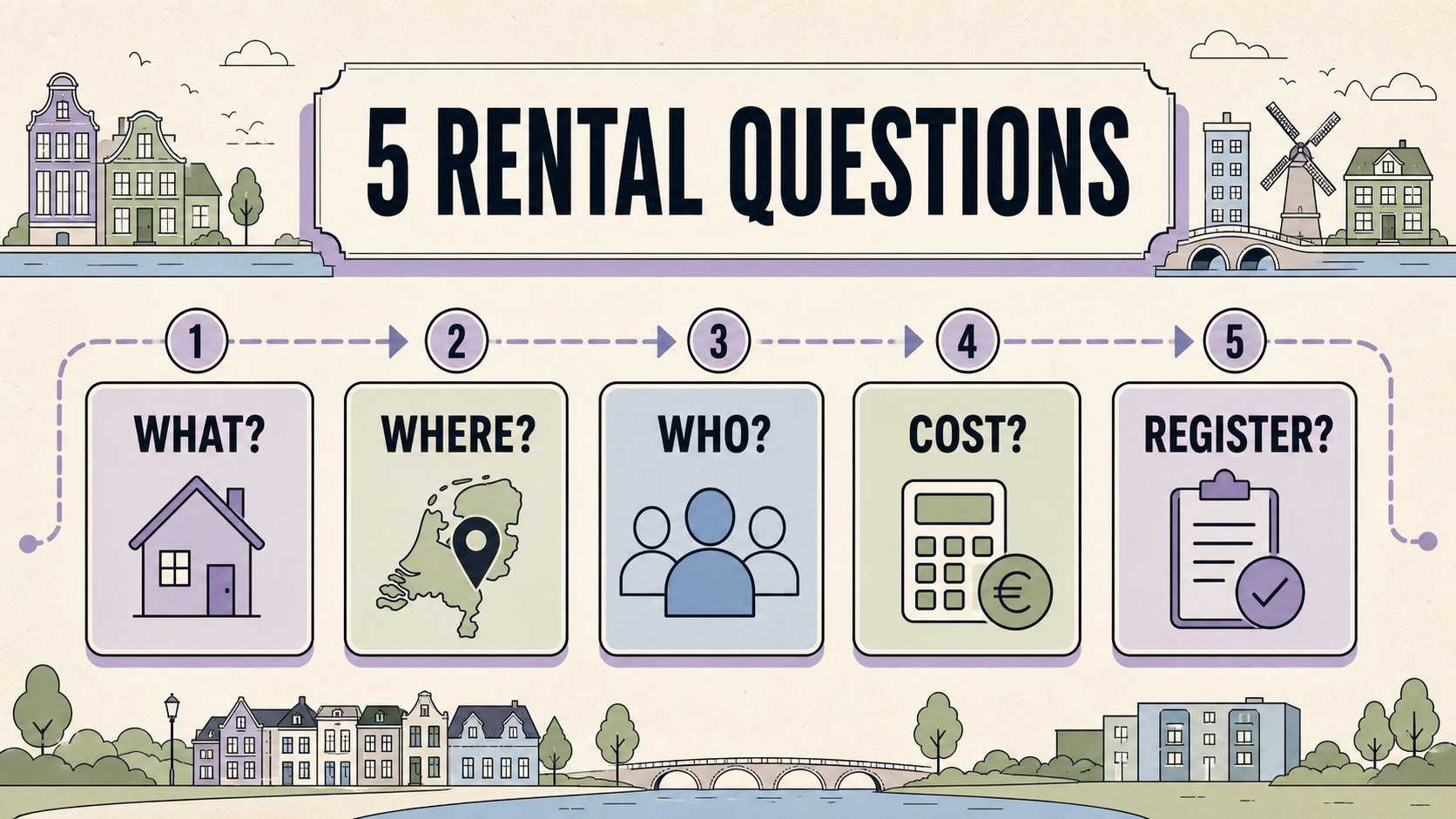
Most rental questions become easier when you put them into five boxes: what is being rented, where it is, who can apply, what it costs, and whether you can register. A self-contained home, a room and social housing can overlap in one advert, but each term answers a different question. Start with the facilities, then check the agreement, price conditions, provider rules and municipal process.
Quick navigation
- What is being rented?
- Where and under which rent rules?
- Who can apply?
- What does it cost?
- Can I register?
How to These answers fit this rental search
Save the advert and write down the exact phrase that caused the question. Do not use a general answer to fill in a missing address, facility, contract or provider fact. If the question concerns a specific home, compare the written answer with the agreement; for a rent assessment, the appropriate Huurcommissie Rent Check applies to the home’s facts.
The infographic below gives the five question boxes to use as you read the answers.
Detailed answer: Ask whether the address can be used for your intended stay and what proof of occupancy is available. Shared facilities answer the housing-type question; they do not by themselves answer the registration question. Official registration guidance sets the timing; confirm the address-specific process with the municipality.
What is being rented? {#what-is-being-rented}
What is renting your own home?
Short version: It means using a defined place as a tenant under a tenancy agreement; it does not mean owning the property.
Detailed answer: In everyday language, “your own home” can mean a self-contained apartment or house, but it can also be used loosely for a place where a person lives. Check the entrance, kitchen, toilet and bathroom rather than relying on the phrase. Keep household use, facilities and rent regulation separate with the distinction between self-contained homes, rooms and social housing.
When is a rental a room?
Short version: A room-rental arrangement normally gives you a private room while one or more facilities are shared.
Detailed answer: Ask who uses the entrance, kitchen, toilet and bathroom, and what the agreement says about cleaning, repairs, guests and shared costs. A “studio” label does not prove that the facilities are private. If a facility is shared, start with the shared-accommodation process in the Rent Check.
Can a social home be self-contained?
Short version: Yes. “Social” describes a regulated rent and access context; “self-contained” describes private facilities.
Detailed answer: The two labels sit on different axes. A social home may have its own entrance, kitchen, toilet and bathroom. A room can also have a rent ceiling while remaining a shared-facility arrangement. A distinction between self-contained homes, rooms and social housing tests the relevant question when an advert uses both labels.
Where and under which rent rules? {#where-and-under-which-rent-rules}
What does the Dutch rental market include?
Short version: It includes social, mid-price and private rentals, plus shared accommodation, with rules that depend on the home, agreement date and provider.
Detailed answer: Government.nl describes social, midprice and private non-subsidised housing as rental contexts with different rules. For a self-contained agreement beginning in 2026, the initial base-rent markers are €932.93 for social housing and €1,228.07 for the private-sector threshold; the mid-price band also uses the quality-points range. Those figures are date-specific. A Dutch rental market clarifies which fact belongs to which layer.
Does the advertised rent decide the sector?
Short version: No. The agreement start date, initial base rent, points and physical accommodation all matter.
Detailed answer: Do not add service charges to the initial base rent when applying the sector markers. Record the base rent separately, check whether the home is self-contained, and ask for the points information where it is relevant. An advert can be incomplete even when the number looks precise.
Does every rental have a maximum rent?
Short version: Regulated and shared accommodation have rent ceilings linked to the applicable rules; liberalised private-sector agreements are different.
Detailed answer: The Huurcommissie Rent Check can calculate points and a maximum base rent for self-contained or shared accommodation. A private-sector agreement may not have the same rent ceiling, but it still has contractual and statutory rules. Use the official tool for the actual home rather than treating a headline category as a legal conclusion.
Who can apply? {#who-can-apply}
Who decides access to social housing?
Short version: The housing association or provider applies its allocation and income rules, sometimes alongside regional or municipal conditions.
Detailed answer: Ask who may respond, how household composition and income are tested, whether registration or waiting time is required, and how the offer is allocated. The official social-housing framework does not tell you whether a particular advert is available to your household today. Keep access conditions separate from facilities.
Do I need a BSN to ask about a rental?
Short version: A general enquiry and a municipal registration question are not the same as a provider’s application requirements.
Detailed answer: Ask the landlord or provider which documents are needed at the current stage and why. A BSN, residence position, identity document or income proof can have different roles. Keep those questions separate with the BSN and registration check.
What documents can a landlord ask for?
Short version: The request should connect to a stated application criterion and the current stage of the process.
Detailed answer: Ask what each document proves, who receives it, how it is stored and whether a redacted copy is acceptable. Keep a staged file and do not send unnecessary identifiers under pressure. A rental document set covers a viewing, application and contract sequence.
What does it cost? {#what-does-it-cost}
What is the difference between base rent and the full month?
Short version: Base rent is only one line; the full month can also include service charges, utilities, insurance, internet, travel, parking and furnishing.
Detailed answer: Ask for each recurring amount separately and record which charges are advances and which are fixed. For a planning example, €950 base rent + €200 listed monthly charges = €1,150 before one-time costs. That arithmetic makes the comparison visible; it is not an average Dutch rent. A rental-cost breakdown gives a complete budget structure.
How much can the deposit be?
Short version: The applicable maximum depends on the agreement date and the rules that apply; do not assume that a provider’s requested amount is automatically correct.
Detailed answer: Government.nl’s tenant plan says that for tenancy agreements dated 1 July 2023 onwards, the maximum deposit a landlord can charge is two months’ base rent. Another Government.nl deposit page currently describes a three-month court ceiling, so a date- and situation-specific check is relevant. Ask for the deposit amount, return terms and a receipt in writing; a rental contract review can test those terms before paying.
Can a room be cheaper even when the total month is higher?
Short version: Yes. A lower base rent can be offset by utilities, shared charges, travel, furniture or short-term costs.
Detailed answer: Put the self-contained home and room on the same budget headings. Do not compare a room’s base rent with a home’s all-in amount. Add the recurring lines first, then note deposit, moving and furnishing costs separately.
Can I register? {#can-i-register}
Can I register at every rental address?
Short version: The phrase in a listing does not settle registration; the address, expected stay and municipal rules do.
Detailed answer: Government.nl says that someone living in the Netherlands for longer than four months must register as a resident, generally within five days of arrival. A stay of less than four months can involve non-resident registration. Ask the municipality about the address and bring the occupancy evidence it requests. A landlord’s promise is not a substitute for the municipal process.
Does renting a room prevent BRP registration?
Short version: Not automatically. The answer depends on the actual address, occupancy and municipal requirements.
What if the landlord and municipality give different answers?
Short version: Ask both sides for the relevant fact in writing and treat the municipality as the authority for registration.
Detailed answer: Keep the advert, agreement, address, expected stay and written replies together. Do not sign or pay on the assumption that a verbal promise will resolve the difference later. If the conflict involves another contract or cost issue, send us the contract details with the focused question and seek qualified advice where needed.
Next step
A mixed-label advert needs the terms in the rental basics, the process differences in the distinction between self-contained homes, rooms and social housing, and the contract questions in the rental contract review. If your question is still tied to one listing, contact us through the form with the exact wording, the stage and the one fact you want to verify.
Rental questions often become difficult when a listing mixes a housing type with a rent or access label. If this FAQ does not settle the wording, send the exact question through the contact form and we can help you identify which fact needs checking next.
Ask a rental question →